A free guide from Cima Consulting
How to run a cash-pay therapy practice
Private pay is the fastest way to open: no credentialing wait, no claims, no denials. It also comes with its own rules. Every self-pay client is owed a written good faith estimate on a federal deadline, out-of-network clients need a superbill their plan will accept, and Medicare clients follow rules of their own. Here's how to set it up, from the team that runs a licensed Texas outpatient program with self-pay clients and builds an EHR that writes superbills.
Updated October 24, 2026. Not legal, billing or tax advice: Cima Consulting isn't a law or accounting firm. Confirm current rules with CMS and your own attorney or CPA.
The short answer: to run a cash-pay (private-pay) therapy practice, set one full fee per service, publish it, and give every uninsured or self-pay client a written good faith estimate: within 1 business day of scheduling a visit 3 or more business days out, within 3 business days for a visit 10 or more business days out, and within 3 business days of any request. One estimate can cover up to 12 months of ongoing therapy. Have a signed financial policy (cancellation fee, card on file), give clients who want reimbursement a superbill with your NPI, codes and diagnoses, and honor a client's request not to tell their plan about services they paid for in full. If you're enrolled in Medicare, check its rules before you charge a Medicare client cash.
1. Cash pay, insurance or both
| What changes | Cash pay only | Insurance | Both (hybrid) |
|---|---|---|---|
| When you can open | As soon as the business, forms and EHR are ready | When each plan's contract is effective; most take 60 to 120 days from a complete application | Day one for self-pay; each plan on its effective date |
| Who sets the price | You | The plan's fee schedule | You for self-pay, the plan for its members |
| Paperwork you owe | Good faith estimates, receipts, superbills on request | Eligibility checks, claims, authorizations, appeals | All of it, per client |
| Who you can reach | Clients who can pay your fee, or who'll claim out-of-network benefits | Clients who need their benefits to afford care | Both |
Many practices open hybrid on purpose: self-pay from the first week while credentialing runs, then insurance plan by plan. The license-specific guides cover which plans enroll you: LPCs, LCSWs, LMFTs, psychologists.
2. Set a fee you can live on
This is the method we use with solo clients:
- One full fee per service, the same for everyone. Plans pay the lower of your billed fee or their allowed amount, so your standard fee should sit at or above your best-paying plan's rate, and self-pay is set from there.
- Use Medicare as a reference point, not a target: look up your codes for your locality in the Medicare physician fee schedule search so you know the floor the market sees.
- Work back from your costs. Divide your monthly costs, including the pay you need, by the sessions you'll realistically hold.
- Write down any sliding scale with the criteria and the proof you ask for, and apply it the same way to everyone.
- Review it every January, and give clients written notice before a change.
Worked example (made-up round numbers, not a market survey): a solo therapist whose costs (rent, malpractice, EHR, phone, continuing education, accounting) plus the pay she needs come to $9,000 a month, and who expects 22 attended sessions a week after cancellations.
| Step | Math | Result |
|---|---|---|
| Sessions a month | 22 × 52 ÷ 12 | about 95 |
| Break-even fee | $9,000 ÷ 95 | about $95 per session |
| With room for taxes, slow months and time off | her own margin | her fee is set above break-even |
Run your own numbers in the same three lines. If the fee you need is far above what people near you can pay, that's the signal to add insurance or out-of-network billing, not to discount until the practice can't pay you.
3. Good faith estimates, step by step
The No Surprises Act requires providers to give uninsured and self-pay clients a good faith estimate of expected charges (45 CFR 149.610; CMS). In a therapy practice it works like this:
| Trigger | Deadline for the written estimate |
|---|---|
| Visit scheduled at least 3 business days ahead | Within 1 business day of scheduling |
| Visit scheduled at least 10 business days ahead | Within 3 business days of scheduling |
| Anyone asks what care will cost | Within 3 business days of the request |
| Ongoing weekly therapy | One estimate may cover up to 12 months; issue a new one when the expected care or charges change |
- Ask every new caller whether they have insurance and whether they plan to use it for this care. "Self-pay" includes insured clients who choose not to use their plan.
- What goes on it: the client's name and date of birth; your practice's name, NPI, tax ID and address; the clinician; the service in plain words and the diagnosis code if known; each expected service with its code, quantity and charge; the total; any other provider expected to bill separately; and the required notices.
- The dispute right: if the bill comes in at least $400 above the estimate, the client can dispute it through CMS's patient-provider dispute resolution process, started within 120 calendar days of the bill. CMS's required notice says so in plain words; give it with the estimate and post it where you schedule.
- Keep a copy in the client's record for at least 6 years.
For a weekly client, estimate realistically: 52 weeks of 90837 at your fee, plus the intake. An estimate that's too low invites disputes; one that's honest and a little high costs nothing. Cima EHR doesn't produce good faith estimates yet, so the Solo Practice Launch forms kit includes an editable GFE template under your practice's name.
4. Superbills for out-of-network clients
A superbill is a statement the client sends to their own plan to claim out-of-network benefits. You don't file it. For the plan to process it, it needs:
- Your practice: legal name, address, tax ID (EIN), organization NPI, taxonomy, and the rendering clinician's name, license and individual NPI.
- The client: name, date of birth, address, and the plan's member ID and group number.
- Each service: date, CPT code with any modifier (95 for video), place of service (11 office, 10 telehealth at home, 02 telehealth elsewhere), units, ICD-10 diagnosis codes, and your fee.
- What was paid and the balance, so the plan reimburses the client rather than paying you.
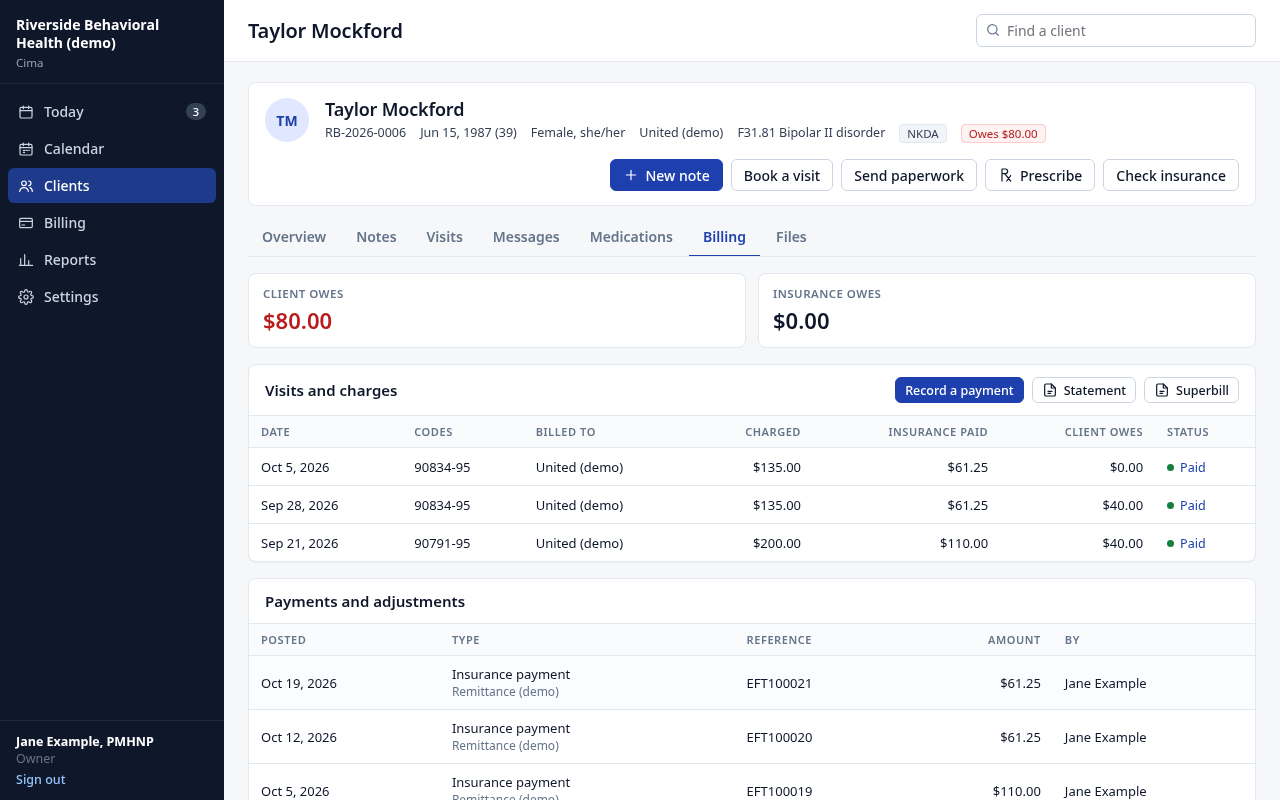
Out-of-network reimbursement depends on the client's plan: many plans have no out-of-network benefit at all, and those that do usually apply a separate deductible and pay a percentage of their own allowed amount, not your fee. Tell clients to call their plan before they count on it; our deductible vs. out-of-pocket guide explains the terms they'll hear. Cima EHR for therapists makes the superbill PDF from the signed notes in one click, with these fields filled in.
5. The financial policy and getting paid
The client signs it before the first visit. Ours covers:
- Your self-pay rates by service, and the right to a good faith estimate.
- Late cancellations and no-shows: how much notice you need (often 24 hours) and the fee. Health plans don't pay for missed appointments, so the fee is the client's; don't charge it where a plan or program's rules forbid it (most Medicaid plans, for example).
- How to pay: cash, check, debit, credit, and HSA or FSA cards. Therapy for a medical condition can qualify as a medical expense; the IRS lists what counts in Publication 502, and the client's plan administrator decides each claim.
- Card on file for session fees and the cancellation fee, with a receipt for every charge. Keep card numbers out of notes and email.
- Balances: statements monthly, due in 30 days, payment plans on request, and what happens after 90 days past due.
- Letters, forms and court work and their fees, so a subpoena isn't a surprise.
Collect at the visit. A cash practice that bills later becomes a collections practice.
6. Privacy when clients pay in full
Some clients pay cash precisely so their plan never learns about therapy. HIPAA gives them that right: when a client pays for a service in full out of pocket and asks you not to disclose it to their health plan, you must agree (45 CFR 164.522(a)(1)(vi)). Record the request in the chart and make sure nobody later sends a claim or a superbill for those dates to the plan by mistake. Statements for self-pay clients should leave diagnoses off unless the client asks for a superbill. The rest of the privacy set-up is in the HIPAA checklist.
7. Medicare, Medicaid and in-network clients
- Medicare: if you're enrolled, you must accept assignment as an LPC or LMFT (Medicare for counselors and MFTs), so you can't charge a Medicare client your cash fee for a covered service instead. If you aren't enrolled, Medicare has specific rules (including formal opt-out and private contracts) about charging its beneficiaries privately; read CMS's current rules before you see Medicare clients self-pay.
- Medicaid: if you're a Texas Medicaid provider, check TMHP's rules and your managed care contracts before charging a Medicaid client privately for a covered service.
- Plans you're in network with: your participation agreement may limit when you can charge that plan's members cash for covered services. Read the contract's member-billing terms before offering a self-pay rate to a member.
8. Taxes and the books
- A separate business account from day one, with every deposit matched to a session. Your EHR's payment report and the bank statement should agree each month.
- Estimated taxes: nobody withholds from cash practice income. Ask your CPA how much to set aside and when to pay the IRS's quarterly estimated taxes.
- Texas franchise tax: an LLC or PLLC files a franchise tax report with the Texas Comptroller each year, usually due May 15, even when no tax is owed.
- Marketing: post your fee and how you handle estimates and superbills on your website and directory listings; it filters calls. Never pay or give anything of value for a referral (Texas Patient Solicitation Act).
Leaving Headway or Alma to run your own billing? See leaving Headway or Alma. Opening from scratch? The full order of steps is in how to start a private practice in Texas, and the telehealth guide covers seeing self-pay clients by video.
Open self-pay now, add insurance when you're ready
The policies and forms kit ($750) gives you the financial policy, good faith estimate, consents and privacy notice under your name. Solo Practice Launch: Essentials ($1,950) adds NPIs, CAQH, three plans and your EHR set up.
Or book a free 30-minute call to talk through your fee and model.
Questions
Do therapists have to give good faith estimates?
Yes, to uninsured clients and to insured clients who choose not to use insurance, under the No Surprises Act. The estimate is due in writing within 1 business day of scheduling a visit 3 or more business days out, within 3 business days for a visit 10 or more business days out, and within 3 business days of a request.
How often do I need a new good faith estimate for weekly therapy?
One estimate can cover recurring services for up to 12 months. Issue a new one when the expected services or charges change, such as a fee increase or a change in frequency.
What happens if the bill is more than the estimate?
If the bill is at least $400 more than the estimate, the client can dispute it through CMS's patient-provider dispute resolution process, started within 120 calendar days of the bill. Estimate honestly and update the estimate when care changes.
What needs to be on a therapy superbill?
The practice's name, address, tax ID and NPI; the clinician's name, license and NPI; the client's name, date of birth and member ID; and for each visit the date, CPT code and modifiers, place of service, units, diagnosis codes, fee and amount paid.
Can clients use an HSA or FSA for therapy?
Often, when the therapy is medical care. IRS Publication 502 lists qualifying medical expenses, and the account administrator decides each claim. Accept HSA and FSA cards and give a receipt or superbill when asked.
Sources
- eCFR, 45 CFR 149.610, good faith estimates for uninsured and self-pay individuals
- CMS, No Surprises Act; good faith estimate required notice
- eCFR, 45 CFR 164.522, right to request restrictions
- CMS, physician fee schedule search
- IRS, Publication 502, medical and dental expenses; estimated taxes
- Texas Comptroller, franchise tax; Texas Legislature, Occupations Code chapter 102
Open self-pay with the paperwork right.
Start with a free 30-minute call about your fee, your forms and when to add insurance.
Book a free call