A free guide from Cima Consulting
How to get credentialed with insurance in Texas
Short answer: get your NPI, line up your tax ID, office address and malpractice coverage, build and attest your free CAQH profile, then apply to each plan your clients carry (commercial plans on their provider sites, Medicare in PECOS, Texas Medicaid through TMHP and then each managed care plan). Follow up every two weeks, read the contract, and bill each plan only from the effective date it gives you in writing. Expect 60 to 120 days per plan. Below is every step for Texas LPCs, LCSWs, LMFTs, LCDCs, psychologists and NPs, the way we run it for clients and for a licensed Texas outpatient program we run.
Updated October 24, 2026. Plans change their processes often; where a rule matters, we link the source so you can check it.
The short version
- Confirm your license lets you bill on your own.
- Get your individual NPI, and an organization NPI if you have a PLLC or other entity.
- Settle the business details plans copy onto every form: legal name, EIN, W-9, service address and bank account.
- Buy malpractice coverage at the limits your plans ask for.
- Gather one credentialing packet and keep it current.
- Build your CAQH profile, authorize your plans to see it and attest it.
- Pick the plans your future clients actually carry.
- Apply to all of them in the same week.
- Follow up every two weeks, sooner when a plan asks for something.
- Read each contract before you sign it.
- Get each effective date in writing, then load it into your EHR and clearinghouse.
- See that plan's members in network only from that date.
- Re-attest CAQH every 120 days, and watch recredentialing and revalidation dates.
Most plans take 60 to 120 days from a complete application. Our guide to how long credentialing takes breaks that down by plan type, with what speeds it up.
1. Check that your license can bill on its own
- LPCs, LMFTs, LCSWs and psychologists are licensed through the boards under the Texas Behavioral Health Executive Council. Fully licensed clinicians can credential in their own name.
- Associates and interns (LPC Associates, LMFT Associates, LMSWs) practice under a supervisor and generally can't be credentialed to bill on their own. Plans that accept them at all usually do so under a supervising clinician in a group; ask each plan.
- LCDCs are licensed by HHSC. Commercial plans differ on whether they credential LCDCs as individuals, and LCDCs generally can't bill Medicare on their own. Check each plan before you count on it.
- Nurse practitioners hold an APRN license from the Texas Board of Nursing and, to prescribe in Texas, a prescriptive authority agreement with a physician. Plans ask for both, plus your DEA registration if you prescribe controlled substances.
Write down each license number, its issue date and its expiration date. Every application asks, and an expiration in the middle of a review stalls it.
2. Get your NPIs
An NPI is free from NPPES and usually issued within days. You get one individual NPI (Type 1) for life. If you practice through a PLLC, professional corporation or other entity, the entity gets its own organization NPI (Type 2), tied to its EIN, so it can bill as the business. Sole proprietors use only their Type 1. Which you need, the taxonomy code to pick, and how both NPIs show up on claims are in NPI Type 1 vs Type 2.
3. Line up the business details
Plans copy the same few facts onto your file, and most stalled applications come from one of them not matching another.
- Legal name and tax ID. Use the name exactly as it appears on the IRS letter that issued your EIN (or your own name and SSN as a sole proprietor), on the W-9, on the Type 2 NPI and on every application.
- Service address. A physical address where you see clients. Most plans won't take a PO box, and many won't list a virtual office. If you see clients only by video, ask each plan how it lists a home-based practice before you apply.
- Billing address and bank account. In the business's name, for electronic payments (EFT).
- A phone number and email that will still work in a year. Plans send requests there, and a missed request can close your file.
Opening the practice from scratch? Our guide to starting a private practice in Texas covers the entity, EIN and office steps.
4. Buy malpractice coverage
Nearly every plan requires professional liability insurance, and many ask for $1 million per claim and $3 million a year. Check each plan's requirement before you buy, and have the policy name the entity as well as you if you practice through one. Upload the declarations page (the page that shows your name, limits and policy dates), not just a certificate.
5. Build the credentialing packet once
One folder, kept current, saves you from hunting for the same page six times:
- Professional license, and for NPs the prescriptive authority agreement and DEA certificate
- NPI numbers (Type 1, and Type 2 if you have an entity)
- Signed W-9 and the IRS EIN confirmation letter
- Malpractice declarations page
- CV with the month and year for every job, and a short note for any gap
- Diplomas and any board certificates
- Voided check or bank letter for direct deposit
6. Build and attest your CAQH profile
Most commercial plans, and the Texas Medicaid managed care plans, read your CAQH profile instead of a long paper application. It's free for providers. You fill it in once, upload your documents, authorize the plans you're applying to, and attest that it's accurate. Then you re-attest every 120 days, or plans can't use it. In June 2026 CAQH renamed itself DataSpring, and ProView is now called the Provider Data Portal; your login, your CAQH ID and the 120-day cycle didn't change. The full walkthrough, with the errors that stall applications, is in our CAQH ProView guide.
7. Choose your plans
Start with the plans your future clients carry, not the longest list you can find. Ask the referral sources you already know (primary care offices, schools, employers' EAPs) which cards they see most. In Texas the usual first set for a therapist looks like this:
| Plan | How you get in | Reads CAQH |
|---|---|---|
| Blue Cross and Blue Shield of Texas | Request to join on BCBSTX's provider site (many steps run through Availity). Usually the largest commercial plan in Texas. | Yes |
| Aetna | Request to join through Aetna's provider site; requests run through Availity. | Yes |
| Cigna (Evernorth Behavioral Health) | Cigna's behavioral health network is managed by Evernorth; apply on Evernorth's provider site. | Yes |
| UnitedHealthcare (Optum) | Behavioral health clinicians apply through Optum's Provider Express. Prescribers billing medical visits also deal with UHC's medical side. | Yes |
| Medicare | Enroll in PECOS. Open to LCSWs, psychologists, NPs and, since January 1, 2024, LPCs and LMFTs. Not LCDCs on their own. | No |
| Medicare Advantage (Humana and others) | Each plan credentials you separately, usually after you're enrolled in Medicare. | Yes |
| Texas Medicaid | Enroll with TMHP, then credential with each Medicaid and CHIP managed care plan in your service area. | TMHP no; the plans yes |
| Marketplace plans | Ambetter in Texas runs through Superior HealthPlan; Oscar has its own provider site. | Yes |
| EAP and benefit networks | ComPsych, Lyra, Spring Health and similar recruit for their own networks, with their own rates and rules. | No |
Before you apply, check which company actually manages the behavioral health benefit: the name on the card often isn't the network you join. Our sister site explains behavioral health carve-outs. Some panels are closed in some areas; an honest "closed" now beats a 90-day wait for the same answer.
8. Apply
- Commercial plans: find the "join our network" or "request participation" page on each plan's provider site. Many start with a short request form; the plan then reads CAQH and sends a contract if it approves you. Put your CAQH ID on every request.
- Medicare: enroll online in PECOS. In Texas, Novitas Solutions processes Medicare enrollments as the Jurisdiction H contractor. If you'll bill through a PLLC or group, the entity enrolls too, and you reassign your Medicare payments to it. There's no application fee for individual clinicians or clinician groups. File before you start seeing Medicare clients (see step 12).
- Texas Medicaid: enroll through TMHP's online enrollment system (PEMS), then apply to each managed care plan in your area. The plans share one credentialing verification organization run through the Texas Association of Health Plans, so your documents are verified once for all of them. LPCs and LMFTs must enroll in Medicare before Texas Medicaid, unless they qualify for the pediatric exemption.
- Joining a group? You're still credentialed individually, then linked to the group's tax ID and NPI with each plan. A missing link is one of the most common reasons a new clinician's claims deny. For Texas Medicaid, the managed care plans must offer an expedited process to LCSWs, LPCs, LMFTs and psychologists who join an established group that already has a contract, if the clinician is Medicaid-enrolled (1 TAC §353.423). Ask the plan how it applies.
Apply to every plan you've chosen in the same week. Credentialing runs in parallel, not in sequence, and waiting for one plan before applying to the next adds months. If you'd rather hand this part off, our insurance credentialing service files each application complete and tracks it to the effective date.
9. Follow up on a schedule
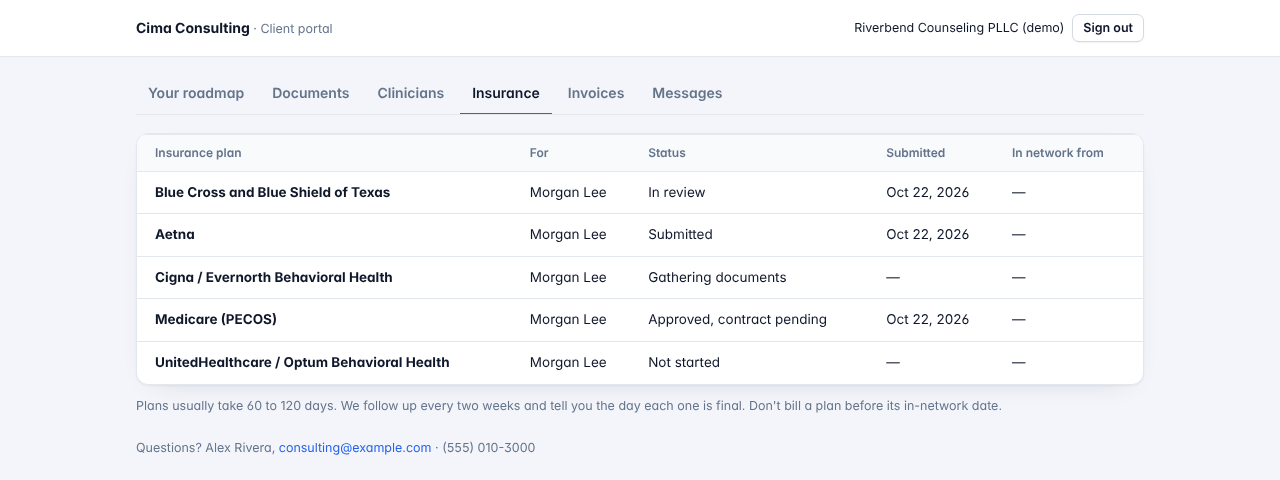
Applications don't move because you wait. They move because someone calls, gets a reference number, and asks what's missing. This is the follow-up schedule built into our client portal, by status, and the routine our credentialing team works every day:
| Status | What it means | Follow up |
|---|---|---|
| Gathering documents | Packet and CAQH still being finished. | Every 7 days |
| Submitted | Application in; the plan hasn't confirmed it's complete. | Every 14 days |
| In review | The plan is verifying your file. | Every 14 days |
| Payer asked for more | A document, signature or answer is missing. | Within 3 days |
| Approved, contract pending | Credentialing passed; the contract hasn't arrived. | Every 10 days |
| Contract to sign | Read it, then sign and return it. | Within 5 days |
| Contract signed, waiting on load | The plan is setting you up in its claims system. | Every 14 days |
| In network | Effective date and provider ID confirmed in writing. | Done; recredentialing tracked |
Keep a log for each plan: the date, who you spoke to, the reference number and what they said. When a plan says "we never received it," the log is how you avoid starting over.
10. Read the contract before you sign
- Rates for your codes. Ask for the fee schedule in writing, at least for the codes you'll bill most (for therapists, usually 90791, 90834 and 90837). "Rates per our standard schedule" with no numbers isn't enough to decide on.
- Timely filing. How many days after the visit a claim can be sent. Miss it and the claim is lost.
- Termination. How much notice either side must give, and what happens to clients mid-treatment.
- Who the contract is with. Your entity (its tax ID and Type 2 NPI) or you as an individual. It should match how you'll bill.
- The effective date, and which plans or products it covers (commercial only, or also Medicare Advantage or marketplace plans).
You sign every application and contract yourself. If something in a contract worries you, ask your attorney; Cima Consulting isn't a law firm.
11. Get the effective date in writing
"Approved" isn't "in network." You're in network on the effective date the plan gives you, once you're loaded in its system. Get the date and your provider ID in writing (a welcome letter or email), then:
- Load the plan, your provider ID and the effective date into your EHR.
- Add the plan's payer ID at your clearinghouse, and enroll in its electronic remittance (ERA) and direct deposit (EFT).
- Check the plan's online directory a few weeks later to see that your listing is right.
- Send the first claim and watch it until it pays. A clean first claim proves the setup.
12. Don't bill before your effective date
Claims for a plan's members dated before your effective date usually deny, and you can't fix that by changing the date of service. Never backdate anything. Until a plan is effective, you have honest options:
- Self-pay, with a good faith estimate before the first visit, as the No Surprises Act requires for uninsured and self-pay clients.
- Out of network, with a superbill the client sends to their plan, if they have out-of-network benefits and agree to it in writing.
- Medicare is the exception, within limits. For clinicians, Medicare's effective date is the later of the date the contractor receives the application it approves and the date you first saw clients at that location, and you may bill for up to 30 days before that date if the circumstances kept you from enrolling earlier (42 CFR 424.520 and 424.521). That's why you file in PECOS before your first Medicare client, not after.
Commercial plans set their own effective-date rules in the contract. Read yours, and ask the plan in writing if it isn't clear.
13. Keep it current
- CAQH: re-attest every 120 days and upload renewed licenses and malpractice pages as they come.
- Recredentialing: plans re-check your file about every three years. A missed request can drop you from the network.
- Medicare: revalidate about every five years when CMS asks. Texas Medicaid: revalidate at least every five years in PEMS; HHSC suggests filing at least 120 days before your due date.
- Changes: update NPPES within 30 days of a change to your NPI information, and tell every plan when your address, phone, entity or tax ID changes. NPPES updates don't update Medicare; change PECOS too.
Coming from Headway or Alma
Networks like Headway and Alma credential you under their contracts, so leaving means getting your own. You keep your NPI, and your CAQH profile is yours. Apply to your own plans while you keep seeing clients through the network, then move insured clients as each of your own contracts becomes effective. Read your network agreement for notice periods and any rules about clients you met through it. Cima EHR's page on leaving Headway or Alma shows what a network keeps from your sessions and how the move works.
Questions
Can I get credentialed before I open my practice?
Yes, and you should start as soon as your NPI, entity, tax ID and office address are settled, because plans take months. Plans need a real service address, so pick the office first.
How many plans should a new solo practice join?
Usually three to six: the largest commercial plans in your area, plus Medicare if your license qualifies and you want older clients. More plans means more paperwork and more rates to manage; start with the ones your clients carry and add later.
What if a plan says its panel is closed?
Ask whether it's closed for your license type and county, and whether it makes exceptions for a specialty, a language or an underserved area. Then apply elsewhere and ask again in six months. Some plans reopen.
Do I need a separate application for each plan if I join a group?
Yes. Each plan credentials you as an individual and then links you to the group's contract. The group's contract doesn't cover you until you're credentialed and linked.
Can a credentialing service guarantee I'll get in?
No one honestly can. Each plan decides, and some close panels. A good service makes every application complete the first time, follows up on a schedule, and tells you plainly when a plan says no.
Can LCDCs get credentialed with insurance in Texas?
With some plans. Commercial plans differ on whether they credential LCDCs as individuals, and Medicare generally doesn't pay LCDCs on their own. Many LCDCs bill through a licensed treatment program or a group instead. Ask each plan about your license type before you apply.
Want it done for you?
We build your CAQH profile, file every application complete, follow up every two weeks and confirm each effective date in writing. Priced per item: the CAQH profile is $250 per clinician and each plan is $175 per plan.
Opening the whole practice? The Solo Practice Launch: Essentials includes your NPIs, CAQH and three plans; Complete includes six. Or book a free 30-minute call.
Sources
- Texas Behavioral Health Executive Council, bhec.texas.gov
- CMS, Marriage and family therapists and mental health counselors in Medicare
- eCFR, 42 CFR 424.521, retrospective billing (via Cornell LII)
- Novitas Solutions, Jurisdiction H contract award (Texas)
- Texas Association of Health Plans, Credentialing 101 (Texas Medicaid CVO)
- Blue Cross and Blue Shield of Texas Medicaid, Medicare enrollment required for LPCs and LMFTs
- Texas Administrative Code, 1 TAC §353.423, expedited credentialing
- HHSC, Texas Medicaid provider revalidation
- eCFR, 45 CFR 162.410, NPI updates within 30 days; CMS, NPI fact sheet
- Becker's, CAQH rebrands to DataSpring
- CMS, No Surprises Act
Get in network without the guesswork.
Start with a free 30-minute call about your plans and your timeline.
Book a free call