A free guide from Cima Consulting
How to open a psychiatric nurse practitioner practice in Texas
Texas nurse practitioners can own their own practice, but they prescribe under an agreement with a delegating physician, and prescribing adds steps that run in a fixed order: the agreement, then the DEA registration at your office address, then the Texas PMP and controlled-substance e-prescribing. Here is that order, with what each step needs, built from the 70-step Texas prescriber roadmap we run with our own clients.
Updated October 24, 2026. Not legal or clinical advice: Cima Consulting isn't a law firm. Confirm prescribing rules with the Texas Board of Nursing and the Texas Medical Board, and have a health-care attorney review the delegation agreement and your ownership structure.
The short answer
To open a PMHNP or FNP practice in Texas you need: an APRN license with prescriptive authority from the Texas Board of Nursing; a signed prescriptive authority agreement with a delegating physician who registers the delegation with the Texas Medical Board (Texas Occupations Code chapter 157); a business entity and NPIs; an office address; a DEA registration at that address; a Texas PMP account; controlled-substance e-prescribing; and contracts with insurance plans. The order matters: the DEA registers you at a practice address, so the office comes before the DEA, and e-prescribing of controlled substances comes after both.
The business basics every practice shares (entity, EIN, malpractice, HIPAA, fees) are in how to start a private practice in Texas. This guide covers what prescribing adds.
How long it takes
On our Texas roadmap, a prescriber practice opens in about 15 weeks on the earliest path, a few weeks later than a therapy practice, because the agreement, the DEA registration and e-prescribing happen one after another. Insurance plans start on their own effective dates, usually after you open.
| Step | Typical timing |
|---|---|
| Kickoff and your dated roadmap | Week 1 |
| Individual NPI for each clinician | Weeks 1–2 |
| Business formed with the Texas Secretary of State (you or your attorney file) | Week 4 |
| HIPAA policies and client forms adopted | Weeks 4–6 |
| Prescriptive authority agreement in place (nurse practitioners) | Weeks 5–9 |
| CAQH profile built and attested | Weeks 6–7 |
| Cima EHR set up with your forms and fees | Weeks 7–8 |
| Insurance applications filed, then followed up every 2 weeks | Months 2–5 |
| DEA registration | Weeks 9–13 |
| E-prescribing, including controlled substances | Weeks 14–15 |
| You open and see your first patient | Week 16 |
| Each plan's effective date confirmed | Month 6 |
| Billing each plan from its effective date | Month 6 |
From the kickoff, on the earliest path through our 70-step Texas roadmap. Agencies and insurance plans set their own pace, so treat these as typical, not promised.
1. License, population focus and scope
- APRN license and prescriptive authority. The Texas Board of Nursing licenses APRNs and grants prescriptive authority. Keep both current; every plan application and the DEA ask for them.
- Your population focus sets your scope. A PMHNP is educated and certified for psychiatric care across the lifespan; an FNP for primary care. The Board expects every APRN to practice within their education, certification and role. If you're an FNP planning a mostly psychiatric caseload, read the Board's current scope-of-practice guidance first, and expect plans to ask how your training fits the services you bill.
- Telehealth to Texas patients only on your Texas license. Seeing patients located in another state needs that state's license, and its own prescribing rules.
2. Ownership and the corporate practice of medicine
- An NP can own the practice. Texas nurse practitioners commonly own practices that they and other non-physician clinicians staff. The delegating physician is a contracted party, not an owner or employer, in most of these set-ups.
- Physicians are where it gets complicated. Texas has a strong corporate practice of medicine doctrine: a business owned by non-physicians generally can't employ physicians to practice medicine or split medical fees with them. If you plan to hire a psychiatrist, bring in a physician co-owner, or pay a physician anything beyond a fair fee for delegation, your health-care attorney settles the structure before anything is signed.
- The entity. A professional LLC is formed for a licensed professional service and has ownership limits; confirm with your attorney which entity fits an APRN-owned practice before you file Form 206 with the Texas Secretary of State ($300 filing fee).
3. The prescriptive authority agreement
Texas APRNs prescribe under a prescriptive authority agreement (PAA) with a delegating physician, set out in Occupations Code chapter 157 and the Board of Nursing and Medical Board rules. Physicians opening their own practice skip this step.
What the agreement has to cover
- Who you both are, how to reach each other, and where and what kind of practice it covers.
- The drugs or categories of drugs you may prescribe, and any you may not.
- How you'll consult each other and refer patients, and how patient emergencies are handled.
- How you'll communicate and share patient information, and any alternate physicians who cover.
- A quality assurance and improvement plan: chart review, and regular meetings between you and the physician. The law sets a minimum schedule for those meetings, more often in your first year under the agreement. Read the current requirement in chapter 157 and the Boards' rules, and write your own schedule into the agreement.
Setting it up, step by step
- Find a physician whose practice fits yours (a psychiatrist is ideal for a psychiatric practice; it isn't always required). Ask whether they have room: the law limits how many APRNs and physician assistants one physician may delegate to.
- Agree on the terms and the fee in writing. A delegating physician is usually paid a monthly fee. Your attorney reviews the agreement and the fee: pay for the physician's time and oversight at fair market value, never per prescription, per patient or per referral.
- Sign the agreement and keep it where you practice. The physician registers the delegation with the Texas Medical Board.
- Put the meetings and chart reviews on the calendar and document each one. That record is what a Board or a plan asks for.
- Update it when anything changes: a new site, a new alternate physician, a new kind of prescribing.
Plans ask for the agreement too. On our credentialing checklist for Texas NPs: the signed agreement, the physician's name, Texas license number and NPI, and confirmation that the physician has registered the delegation with the Texas Medical Board. Have all four ready before the first plan application.
4. DEA registration
- Register at your practice address in each state where you prescribe controlled substances, through DEA Diversion Control. You can't register before you have the office, which is why the lease is early on the roadmap.
- The fee on our roadmap is $888 for three years (check the DEA's current fee when you apply).
- No separate Texas registration. Texas ended its state controlled-substance registration in 2016, so in Texas the DEA registration is the one you need.
- Telehealth prescribing of controlled substances to patients you haven't seen in person has its own federal rules, which have changed several times. Check the DEA's current telemedicine rule before you build a telehealth-only controlled-substance practice.
5. Controlled substances, the PMP and e-prescribing
- Schedule II is limited for Texas APRNs. Under chapter 157, a physician may delegate Schedule II prescribing to an APRN only in limited settings, such as hospital facility-based practice and hospice care, not an ordinary outpatient office. For a psychiatric practice that matters most for ADHD stimulants, which are mostly Schedule II. Plan how those patients will be served (a psychiatrist partner, or referral) before you open, and confirm the current rule with the Board of Nursing.
- Schedules III to V can be delegated in your agreement, within the limits the statute and rules set on supply and refills.
- The Texas PMP. Register with PMP AWARxE through the Texas State Board of Pharmacy. Texas prescribers must check the PMP before prescribing opioids, benzodiazepines, barbiturates or carisoprodol, so in a psychiatric practice you'll check it for every benzodiazepine. If your e-prescribing connects to it, the check is one click.
- Electronic prescriptions. Texas, many other states and Medicare Part D require controlled-substance prescriptions to be sent electronically, with few exceptions. Electronic prescribing of controlled substances (EPCS) needs identity proofing and two-factor sign-in for each prescriber, set up after the DEA registration.
6. Credentialing an NP practice
- NPIs. Your own Type 1 NPI with the nurse practitioner taxonomy that matches your certification, and a Type 2 NPI for the practice, both free from NPPES.
- Medicare enrolls nurse practitioners. Enroll in PECOS and reassign your billing to the practice; there's no application fee for individual clinicians.
- Texas Medicaid: enroll through TMHP, then with each Medicaid managed care plan in your area. Texas Medicaid plans share one credentialing verification organization, so your documents are verified once for all of them (Texas Association of Health Plans).
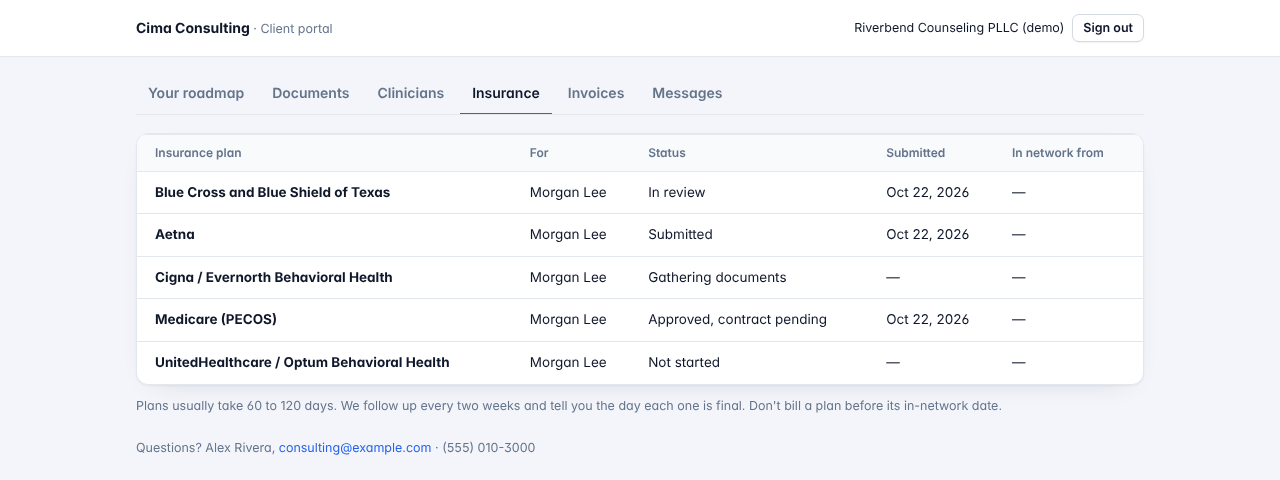
- Commercial plans read your CAQH profile, re-attested every 120 days. Each plan decides panel by panel and county by county, so ask each one whether it is taking psychiatric NPs where you practice before you apply.
- Expect 60 to 120 days per plan from a complete application. Open to self-pay patients while you wait. Our credentialing service prices each plan separately, and the Prescriber Practice Launch includes eight plans, Medicare and Medicaid among them.
7. Protocols, labs and billing codes
Write these before the first patient
- Prescribing protocols: controlled-substance agreements, when you check the PMP, drug testing for patients on controlled medications, refill and lost-prescription rules, and how you coordinate with each patient's therapist.
- Safety screening: PHQ-9, GAD-7 and the Columbia suicide screen at intake and on a schedule, and a crisis procedure that says when you call 988, a mobile crisis team or 911.
- Labs. Open an account with a reference lab for monitoring labs and confirmation drug tests. In-office instant drug screens need a CLIA certificate of waiver (form CMS-116, a small fee every two years). Never accept money, staff or perks from a lab in return for sending tests: the anti-kickback laws and EKRA cover labs.
- 42 CFR Part 2. A DEA registration makes a practice "federally assisted." If you hold yourself out as treating substance use disorders, those records are protected under 42 CFR Part 2.
The codes a psychiatric NP practice bills most
| Visit | Common codes | Notes |
|---|---|---|
| Psychiatric evaluation | 90792 | Diagnostic evaluation with medical services; some plans prefer a new-patient E/M code instead. Check each contract. |
| Medication management | 99212–99215 (established), 99202–99205 (new) | Chosen by medical decision-making or total time on the date of the visit. |
| Med management with therapy | E/M plus 90833, 90836 or 90838 | Psychotherapy add-on codes; the therapy time is separate from the E/M work and documented on its own. |
| Therapy only | 90832, 90834, 90837 | Within your license and the codes each plan pays you for. |
8. An EHR with e-prescribing
A prescriber needs an EHR that codes E/M visits, keeps the medication list, runs PHQ-9 and GAD-7 with safety alerts, and sends prescriptions, including controlled substances, through a certified EPCS network. Cima EHR for nurse practitioners does the visits, coding, screenings and claims today on the Solo Prescriber plan (see pricing). E-prescribing in Cima, controlled substances included, is coming soon: we're connecting a certified network now. Until it's live in your account, you'd prescribe through a standalone certified EPCS service, and we'll tell you on your call exactly where it stands for your opening date.
Want every registration in order, on a dated roadmap?
The Prescriber Practice Launch is $4,950 flat: everything in the solo launch, plus the DEA and PMP, the prescriptive authority checklist, EPCS set-up, CLIA if you need it, and eight insurance plans including Medicare and Medicaid. Paid 50% at signing and 50% when the insurance applications are submitted.
Opening with therapists or more prescribers? See how to start a group practice in Texas and the Group Practice Launch. Or book a free 30-minute call.
Questions
Can a nurse practitioner own a practice in Texas?
Yes. Texas NPs commonly own their practices. They prescribe under a prescriptive authority agreement with a delegating physician, who is usually a contracted party rather than an owner. Employing or co-owning with physicians raises corporate practice of medicine questions for your attorney.
Do Texas NPs need a supervising physician?
Texas APRNs prescribe under a prescriptive authority agreement with a delegating physician, with chart review and regular meetings set by law and written into the agreement. Confirm the current requirements with the Board of Nursing and the Texas Medical Board.
How much does a delegating physician cost?
It's negotiated, usually as a monthly fee. Pay for the physician's time and oversight at fair market value, never per prescription, patient or referral, and have your attorney review the agreement and the fee.
Can a Texas PMHNP prescribe ADHD stimulants?
Most stimulants are Schedule II, and Texas allows Schedule II delegation to APRNs only in limited settings such as hospital facility-based practice and hospice, not a typical outpatient office. Confirm the current rule with the Board of Nursing and plan a partner or referral path for those patients.
Can I apply for a DEA registration before I have an office?
No. The DEA registers you at a practice address in the state where you prescribe, so sign the lease first. Texas has no separate state controlled-substance registration.
Does Cima EHR do e-prescribing?
It's coming soon, controlled substances included, through a certified network. Visits, E/M coding, screenings and claims work today. Until e-prescribing is live in your account, use a standalone certified EPCS service.
Sources
- Texas Legislature, Occupations Code chapter 157 (delegation, prescriptive authority agreements)
- Texas Board of Nursing, bon.texas.gov; Texas Medical Board, tmb.state.tx.us
- DEA, Diversion Control Division (registration)
- Texas State Board of Pharmacy, Prescription Monitoring Program
- Texas Secretary of State, Form 206 instructions
- CMS, NPPES and PECOS; TMHP, Texas Medicaid enrollment
- eCFR, 42 CFR Part 2