A free guide from Cima Consulting
How to start a group practice in Texas
Going from one clinician to several is a different business, not a bigger caseload. The group needs its own contracts with insurance plans, employees or contractors set up the right way, supervision that a board and a plan can follow, and a pay plan that still works after the plan pays you. Here is the order we use, built from the 79-step Texas group roadmap we run with our own clients.
Updated October 24, 2026. Not legal or tax advice: Cima Consulting isn't a law or accounting firm. Make entity, ownership, worker-classification and pay decisions with your own health-care attorney and CPA.
The short answer
To start a group practice in Texas: settle ownership and the entity with your attorney (a professional LLC can be owned only by licensed professionals), get the group its own Type 2 NPI and tax ID, contract the group with each insurance plan and link every clinician to it, decide with your CPA who is an employee and who is a contractor, write a supervision plan for any associates, and set a pay plan that pays clinicians for their own work, never for referrals. Credentialing each new clinician takes 60 to 120 days per plan, so it starts the day they accept your offer, not the day they start.
If you haven't opened a practice at all yet, start with how to start a private practice in Texas; this guide picks up where that one ends. Adding a nurse practitioner or an LCDC? Their rules are in opening a psychiatric NP practice in Texas and LCDC private practice in Texas.
How long it takes
On the earliest path, a new group opens in about 17 weeks: business, NPIs, policies and the first hires done before the first client. The contracts take longer, because each plan has to approve the group and then link each clinician to it.
| Step | Typical timing |
|---|---|
| Kickoff and your dated roadmap | Week 1 |
| Individual NPI for each clinician | Weeks 1–2 |
| Business formed with the Texas Secretary of State (you or your attorney file) | Week 4 |
| HIPAA policies and client forms adopted | Weeks 4–6 |
| CAQH profile built and attested | Weeks 6–7 |
| Cima EHR set up with your forms and fees | Weeks 7–8 |
| Insurance applications filed, then followed up every 2 weeks | Months 2–5 |
| Team hired and verified | Weeks 8–14 |
| The group opens | Month 4 |
| Each clinician linked to the group's contracts | Months 5–6 |
| Each plan's effective date confirmed | Month 6 |
| Billing each plan from its effective date | Month 6 |
From the kickoff, on the earliest path through our 79-step Texas roadmap. Agencies and insurance plans set their own pace, so treat these as typical, not promised.
1. Pick the kind of group you're building
"Group practice" covers several very different set-ups. Choose one on purpose, because it decides who signs the contracts, who carries the liability and how claims are paid.
| Model | How it works | Watch for |
|---|---|---|
| Owner plus employees | One owner's entity holds the contracts; clinicians are W-2 employees who bill under the group's NPI and tax ID. | Payroll, unemployment tax and a handbook from the first hire. The most control, and the most cost. |
| Owner plus contractors | The group holds the contracts; clinicians are 1099 contractors linked to the group's contracts. | Classification is decided by how the work is controlled, not by what the contract says (see hiring). |
| Co-owners | Two or more licensed clinicians own the entity together. | An operating agreement that covers money in, money out, decisions, and what happens when someone leaves or dies. |
| Shared office, separate practices | Each clinician keeps their own practice, contracts and records, and splits rent and a front desk. | This isn't a group for insurance: each person bills on their own contracts. Don't advertise as one practice if you aren't one. |
2. Entity and ownership
- Professional entities have ownership limits. A Texas professional LLC (PLLC) or professional corporation is formed to provide a licensed professional service, and its owners must be licensed to provide it. Some combinations of professions may own one together and others may not. If you want an unlicensed partner, an investor, or a co-owner with a different license (say, an LPC and a nurse practitioner), have your attorney confirm the structure before anything is filed.
- Physicians change the picture. Texas has a strong corporate practice of medicine doctrine. If the group will employ or contract with a physician, including a psychiatrist, who may own it is a question for a health-care attorney first. Our psychiatric NP practice guide covers what that means for prescribers.
- Grow the entity you have, or form a new one. If your solo practice is already a PLLC with its own EIN and Type 2 NPI, the simplest path is often to grow it: the contracts, bank account and records stay put. A new entity means a new tax ID, and plans treat a new tax ID as a new contract. Ask your attorney and CPA which fits, then decide before you file anything with a plan.
- File with the Texas Secretary of State. A PLLC's certificate of formation is Form 206, filed through SOSDirect, with a $300 filing fee (Texas SOS). Add an assumed name certificate if the group will use a trade name, and use the same legal name, exactly, on the NPI, the IRS letter, the bank account and every plan application.
- Co-owners: sign an operating agreement. Capital, draws, who decides what, how a departing owner is bought out, who keeps the patient records, and the non-solicitation terms your attorney says are enforceable in Texas.
3. Group NPI and group contracts
- The group's Type 2 NPI comes free from NPPES, tied to the group's EIN. Every clinician keeps their own Type 1 NPI for life; on a claim, the clinician is the rendering provider and the group is the billing provider.
- Contract the group with each plan. Most commercial plans contract with the group (its tax ID and Type 2 NPI), then credential each clinician and link them to the group. Claims pay the group only when that link is in place, and a missing link is one of the most common reasons a new clinician's claims deny.
- Moving your solo contracts. If you've been in network under your own name or Social Security number, ask each plan how to move to the group's tax ID: some add a new group record, some need a new application. Keep billing under the old arrangement until each plan confirms the change in writing.
- Medicare: enroll the group in PECOS and reassign each clinician's Medicare billing to it. There's no application fee for individual clinicians or clinician groups.
- Texas Medicaid: the group and each clinician enroll through TMHP, then with each Medicaid managed care plan in your area. LPCs and LMFTs must be enrolled in Medicare before Texas Medicaid, unless they qualify for the pediatric exemption (BCBSTX Medicaid notice).
- Rosters. Every time someone joins or leaves, each plan needs to hear about it. Keep a roster per plan: clinician, NPI, effective date, linked date, recredentialing date. Our credentialing service does this per plan, or as monthly upkeep.
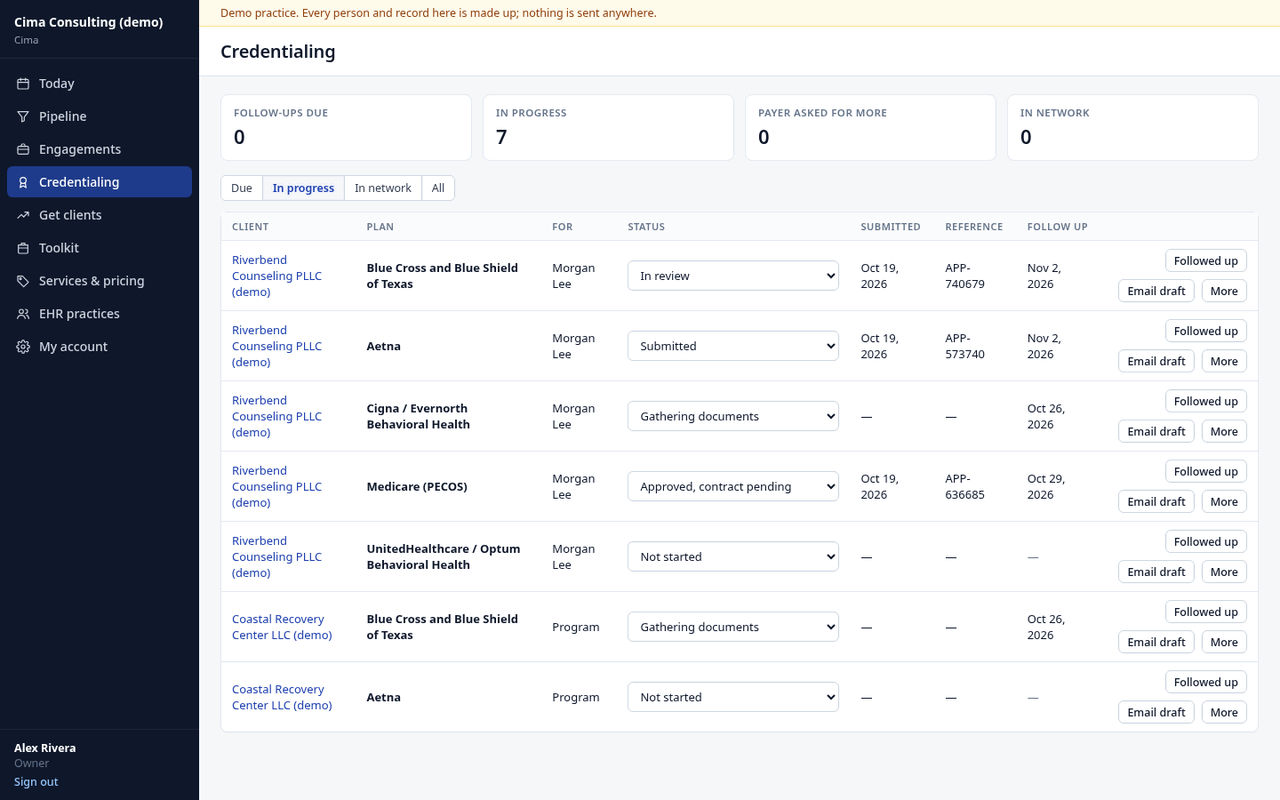
On our own credentialing board, every clinician-and-plan pair moves through the same statuses: gathering documents, submitted, in review, payer asked for more, approved, contract to sign, signed, linked, in network, with a follow-up date every two weeks. The Group Practice Launch runs that board for the group's contracts and its first clinicians.
4. Hiring: W-2 employee or 1099 contractor
It isn't a preference. The IRS looks at the whole relationship: behavioral control (who decides how, when and where the work is done), financial control (who pays the expenses, who can make or lose money), and the relationship itself (benefits, permanence, whether the work is the core of your business) (IRS). The Texas Workforce Commission applies its own test for state unemployment tax. A clinician who works your schedule, in your office, with your forms and your supervision, and sees only your clients, looks a lot like an employee whatever the contract calls them. Decide each role with your CPA and attorney before you make an offer.
| W-2 employee | 1099 contractor | |
|---|---|---|
| You can require | Hours, training, your methods and forms, supervision | The result, the documentation standard, your policies on privacy and records |
| You pay | Wages plus employer payroll taxes, Texas unemployment tax, any benefits | The agreed fee; they pay their own taxes and expenses |
| Set up first | A payroll service, a TWC tax account, new-hire reporting, a handbook | A written contractor agreement, a W-9, their own malpractice |
| Risk if wrong | Few, if paid and taxed right | Back taxes and penalties if the role is really employment |
Credentialing is the long pole. Start each new clinician's NPI, CAQH profile, plan applications and link to the group the week they accept your offer; it takes 60 to 120 days per plan. Until each plan's effective date, schedule them with self-pay clients or members of plans that already list them, and never bill a plan for them before that date.
The first-hire checklist, in the order we run it
These are the staffing steps from our Texas group roadmap. Each one waits on the one before it, which is why they start well before opening day.
| Step | What it involves | Typical time |
|---|---|---|
| 1. Staffing plan and job descriptions | Each role, when you need it, its pay, and the license it requires. Decide with your CPA which roles are employees and which are contractors. | 2 weeks |
| 2. Payroll and a TWC tax account | A payroll service for withholding, deposits and W-2s; new-hire reporting; a Texas Workforce Commission unemployment tax account with quarterly wage reports. | 1 week, after the EIN and bank account |
| 3. Workers' comp decision | Optional for most Texas private employers. Carry it, or notify the state and your employees that you're a non-subscriber (Texas Department of Insurance). | 1 week |
| 4. Handbook | Hours, pay, leave, conduct, confidentiality, social media, drug-free workplace, complaints. Attorney review before anyone signs that they received it. | 2 weeks |
| 5. Hire | Recruit clinicians and front-desk or billing staff early enough to train them; verify each license with its board (BHEC for LPCs, LMFTs, LCSWs and psychologists; HHSC for LCDCs; the Board of Nursing for NPs) before the start date. | About 6 weeks |
| 6. Background and exclusion checks | Criminal history as your policies require; the federal OIG exclusion list and the Texas Medicaid exclusion list before hire, then monthly. Nobody excluded can work on services billed to federal programs. | 1 week |
| 7. Credential file | License verification, diploma, résumé, references, background check, malpractice, signed job description, training records. | 2 weeks |
| 8. Supervision plan | Who supervises whom, how often and how it's logged (see below). | 1 week |
| 9. Orientation | HIPAA, client rights, emergencies, abuse reporting, suicide risk, documentation and the EHR, with a sign-in sheet in each file. | 2 weeks, before the first client |
5. Associates, interns and supervision
Hiring associates is how many groups grow, and it's where groups get into trouble with boards and plans.
- Associates practice under a board-approved supervisor. LPC Associates, LMFT Associates and LMSWs working toward the LCSW are governed by their boards under the Behavioral Health Executive Council; LCDC counselor interns by HHSC. Each board sets who may supervise, how often, how it's documented, and what clients must be told. Read the current rule for each license before you hire.
- Associates generally can't be credentialed or bill on their own, and plans differ on whether, and how, they pay for an associate's services under a supervisor. Check each plan's written policy before you schedule an associate with its members. Never bill an associate's session as if the supervisor provided it.
- Write a supervision plan: who supervises whom, how often, individual or group, how it's documented and where the logs live. Boards, plans and surveyors ask for those logs.
- Co-sign in the chart. Decide which notes need a supervisor's review and make the EHR enforce it, so nothing is billed before the supervisor signs.
6. Pay models, and the legal lines
Work the pay plan backward from what the plans actually pay you, after no-shows, denials and your overhead, not forward from what clinicians are asking for.
| Model | How it works | Good for | Watch for |
|---|---|---|---|
| Salary | A fixed annual wage for an expected caseload | Employees; associates you're developing | You carry the risk of an empty schedule; set the caseload expectation in writing. |
| Per session | A flat amount for each completed, documented session | Predictable cost per visit; employees or contractors | Pay on a signed note, so documentation keeps up. Pay differs by payer if your rates differ a lot. |
| Percentage of collections | A share of what the group actually collects for that clinician's own services | Sharing payer risk with experienced clinicians | Base it on their own services only. Define "collections" in writing (after refunds and recoupments). |
| Hybrid | A base plus a per-session or percentage amount above a threshold | Moving a clinician from salary toward productivity | Make the threshold reachable and the math visible each pay period. |
A worked example, with made-up numbers. Say a plan pays the group $100 for a 53-minute session and about 8 of every 100 scheduled sessions are no-shows or deny. If overhead (rent, the EHR, billing, the front desk, insurance) runs $35 a session and you want $10 a session of margin, the most you can pay is about $100 × 0.92 − $35 − $10, or roughly $47 a session. Use your own contracted rates and costs; ours aren't yours.
The legal lines
- Pay for work, never for referrals. The Texas Patient Solicitation Act (Occupations Code chapter 102) makes paying or accepting anything of value for patient referrals a crime, whoever pays for the care, and the federal Anti-Kickback Statute covers Medicare and Medicaid. A bonus for bringing in clients, or a cut of a colleague's sessions for having referred them, is exactly what those laws are about.
- Percentage pay for a clinician's own services is a different thing from a percentage for referrals, but how it's written still matters, especially with Medicare or Medicaid clients and especially with physicians. Have a health-care attorney review the pay plan and the offer letter.
- Contractors and percentage rent. If a contractor pays the group a percentage of what they bill in exchange for space, referrals or the group's name, that's the riskiest version of all. Get it reviewed or don't do it.
- Non-competes and non-solicitation have their own Texas rules, with extra limits for physicians. Your attorney decides what's enforceable.
7. Run it like a group
- Name a privacy officer and a security officer, update your HIPAA risk analysis for more people and devices, and give each person only the access their job needs.
- An employee handbook (hours, leave, conduct, confidentiality, social media, complaints), job descriptions that state the license each role needs, and offer letters. Your attorney reviews them before anyone signs.
- One intake path: who answers the phone, who matches clients to clinicians, who checks benefits before the first visit. Our sister product's VOB checklist lists what to ask.
- One billing workflow: claims out within days, ERAs and EFT with every plan, denials worked weekly, each plan's timely filing limit known.
- Monthly numbers by clinician: visits, no-shows, notes signed on time, billed and collected. Problems show up here first.
- Dates that come back: CAQH re-attestation every 120 days per clinician, license and malpractice renewals, recredentialing about every three years, Medicaid revalidation, the franchise tax report each May.
8. An EHR built for groups
A group needs an EHR where each clinician sees their own caseload, associates' notes wait for the supervisor's co-sign before anything is billed, the biller and front desk have their own limited logins, and the owner sees every clinician's visits, open notes and collections in one place. That's how Cima EHR for group practices works: each added clinician is $39 a month, and billing and front-desk logins are free. Claims carry the rendering clinician's NPI with the group's NPI and tax ID. Plans and prices are on the pricing page.
Want the group set up with you?
The Group Practice Launch is $7,500 flat: the group NPI and contracts, two clinicians credentialed with five plans each and linked to the group, hiring papers for your attorney, a supervision plan and payroll choices laid out. Each added clinician is $750.
Adding a prescriber? See the Prescriber Practice Launch. Still solo? The solo packages get you open first. Or book a free 30-minute call.
Questions
Do I need a new entity to start a group practice in Texas?
Not always. If your solo practice is already a PLLC with its own EIN, Type 2 NPI and contracts, growing it is often simplest, because plans treat a new tax ID as a new contract. Co-owners, a different license mix or an outside investor may need a different structure. Decide with your attorney and CPA before filing anything with a plan.
Can a Texas group practice pay therapists as 1099 contractors?
Only if the relationship really is independent. The IRS and the Texas Workforce Commission look at who controls how, when and where the work is done, who carries the costs, and how permanent and central the work is. A clinician on your schedule, in your office, under your supervision usually looks like an employee. Ask your CPA and attorney for each role.
Can LPC Associates work in my group?
Yes, under a board-approved supervisor and the supervision rules of their board. Whether a plan pays for an associate's services, and how, varies by plan, so check each plan's written policy before you schedule them with its members.
Is a percentage split legal?
Paying clinicians a share of what's collected for their own services is common. Paying anyone, in any form, for referring patients is not legal in Texas or under federal law. The details of how a percentage is written matter, so have a health-care attorney review it.
How long until a new clinician can see insurance clients?
Usually 60 to 120 days per plan: an NPI, a CAQH profile, each plan's application and the link to the group. Start the week they accept the offer, and don't bill a plan for them before their effective date.
Sources
- Texas Secretary of State, Form 206 instructions (professional LLC, $300 fee)
- IRS, Independent contractor (self-employed) or employee?
- CMS, NPPES and PECOS
- Blue Cross and Blue Shield of Texas Medicaid, Medicare enrollment required for LPCs and LMFTs
- Texas Behavioral Health Executive Council, bhec.texas.gov
- HHS Office of Inspector General, Exclusions database
- Texas Department of Insurance, workers' compensation
- Texas Legislature, Occupations Code chapter 102 (Patient Solicitation Act)
Grow from one clinician to a group.
Start with a free 30-minute call about your group.
Book a free call