A free guide from Cima Consulting
How to start a private practice in Texas
Every step for a licensed therapist or counselor to open a practice of their own in Texas and take insurance, in the order that keeps you from waiting on paperwork you could have started weeks ago. Built from the 62-step roadmap we use with our own solo clients.
Updated October 24, 2026. Not legal or tax advice: rules and fees change, so check with the agency, and make entity, contract and tax decisions with your own attorney and CPA.
How long it takes
On the earliest path, a solo practice can open to self-pay clients in about 11 weeks. Insurance is the long pole: most plans take 60 to 120 days from a complete application, so start credentialing as soon as your business, NPIs and office address are settled, and plan to see self-pay clients while you wait.
| Step | Typical timing |
|---|---|
| Kickoff and your dated roadmap | Week 1 |
| Individual NPI for each clinician | Weeks 1–2 |
| Business formed with the Texas Secretary of State (you or your attorney file) | Week 4 |
| HIPAA policies and client forms adopted | Weeks 4–6 |
| CAQH profile built and attested | Weeks 6–7 |
| Cima EHR set up with your forms and fees | Weeks 7–8 |
| Insurance applications filed, then followed up every 2 weeks | Months 2–5 |
| You open: self-pay clients can start | Week 11 |
| Each plan's effective date confirmed | Month 6 |
| Billing each plan from its effective date | Month 6 |
From the kickoff, on the earliest path through our 62-step Texas roadmap. Agencies and insurance plans set their own pace, so treat these as typical, not promised.
1. Check that your license lets you practice on your own
- Who licenses whom: the Texas Behavioral Health Executive Council oversees the boards for LPCs, LMFTs, LCSWs and psychologists; HHSC licenses LCDCs.
- Associates and interns (LPC Associates, LMFT Associates, LMSWs, counselor interns) practice under a supervisor and generally can't bill insurance on their own. Open your own practice once you hold the full license, or as part of a group with a board-approved supervisor.
- Keep each license number and expiration date handy: every insurance application asks for them.
2. Plan the practice and the money
- Decide what you'll offer and to whom: therapy, assessments, couples or family work; the ages and problems you'll treat; in person, by video or both.
- Insurance, self-pay or both. This decides which plans you join and which forms you need. Self-pay lets you open before any insurance contract is effective.
- Build the startup budget: every opening cost (fees, insurance, rent, furniture, software) and the monthly cost to run. If you'll take insurance, plan for credentialing to take about three months and the first payments another month after that.
3. Form the business
- Choose the entity with your attorney or CPA. Licensed clinicians often use a professional limited liability company (PLLC) or a professional corporation, and some elect S-corporation taxes. Professional entities limit who can own them.
- File with the Texas Secretary of State through SOSDirect. The certificate of formation for a PLLC is Form 206, and the filing fee is $300 (Texas SOS, Form 206 instructions). You'll name a registered agent with a Texas address.
- File an assumed name certificate if you'll do business under a name that isn't the company's legal name. Use the same names, exactly, on your NPI, bank account and every insurance application.
- Get an EIN from the IRS: free, online and issued right away. Save the confirmation letter; plans ask for it.
- Open a business bank account and set up bookkeeping with your CPA.
- Calendar the franchise tax report. Texas has no personal income tax, but LLCs, PLLCs and corporations file franchise tax and information reports with the Comptroller each year, usually due May 15. Many small businesses owe no tax but still file.
4. Get your NPIs
- Individual NPI (Type 1): yours for life, free from NPPES and usually issued within days. Pick the taxonomy that matches your license.
- Organization NPI (Type 2): the company's own NPI, tied to its EIN, so it can bill as the business. The authorized official must be someone who can legally bind the company.
5. Insure the practice
Nearly every plan requires malpractice coverage, and many ask for $1 million per claim and $3 million a year; check each plan's requirement. Add general liability for the office (landlords ask) and cyber coverage, with the company covered as well as you.
6. Office and telehealth
- Choose the office before the insurance applications. Plans list a physical service address; most won't accept a PO box and many won't list a virtual office. If you'll see clients only by video, ask each plan how it lists a home-based practice.
- Sign the lease in the company's name after your attorney reads it. Add sound privacy, lock paper records, and check that the space is accessible.
- Telehealth: use a video platform that signs a business associate agreement (BAA), get a telehealth consent, and confirm where the client is at each session. You must be licensed in the state where the client is.
7. CAQH and insurance plans
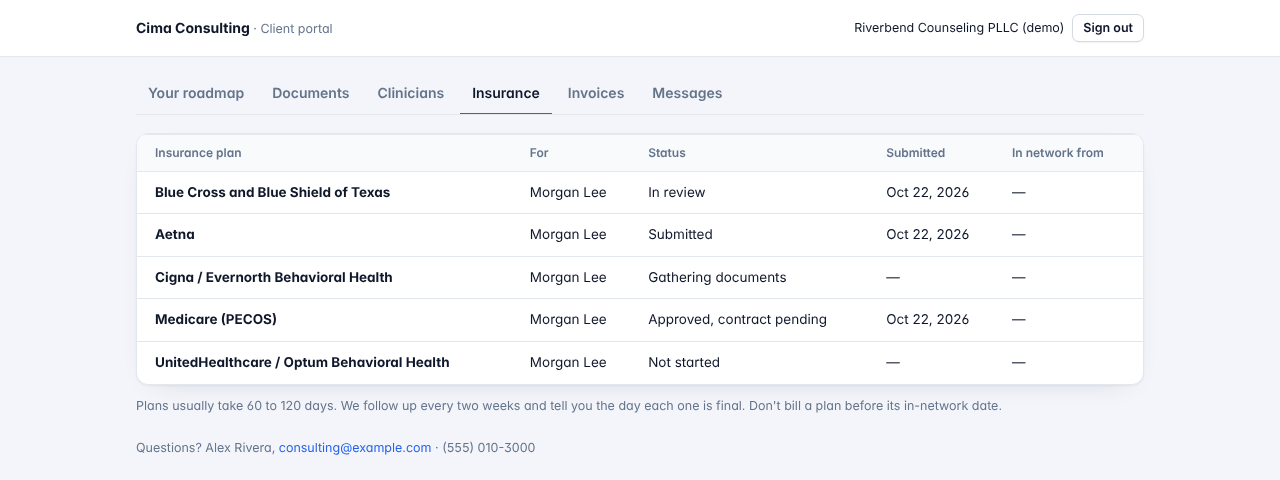
- Pick the plans your future clients actually carry and that are open to new providers in your area. In Texas, Blue Cross and Blue Shield of Texas is usually the largest commercial plan; Aetna, Cigna's Evernorth and UnitedHealthcare's Optum are common next steps.
- Build your CAQH ProView profile. Most commercial plans read it instead of a paper application. It's free for providers, and you re-attest every 120 days or plans can't use it.
- Medicare: since January 1, 2024, Medicare pays LMFTs and LPCs (as marriage and family therapists and mental health counselors), along with LCSWs and psychologists (CMS). Enroll in PECOS and reassign your billing to the practice. LCDCs generally can't bill Medicare on their own.
- Texas Medicaid: enroll through TMHP, then credential with each Medicaid managed care plan in your service area. LPCs and LMFTs must enroll in Medicare first, unless they qualify for the pediatric exemption (BCBSTX Medicaid notice).
- Follow up every two weeks until each plan decides, review each contract (rates, timely filing, termination) before you sign, and get the effective date in writing. Our credentialing page has the details and prices.
8. Policies and client forms
- HIPAA: adopt privacy and security policies, name yourself privacy and security officer, and do a written security risk analysis; then close the gaps (encrypted devices, multi-factor sign-in, backups) (HHS).
- Client paperwork: consent to treatment, notice of privacy practices, telehealth consent, financial and cancellation policy, and release of information.
- Good faith estimates. The No Surprises Act requires a good faith estimate for uninsured and self-pay clients before services (CMS).
- Substance use records. If you hold yourself out as treating substance use disorders and are federally assisted (Medicare, Medicaid or a DEA registration all count), 42 CFR Part 2 protects those records; the updated rule's compliance date was February 16, 2026. Use Part 2 language in your consents and releases.
- A crisis procedure: how you screen for suicide risk, make a safety plan, and when you call 988, a mobile crisis team or 911.
9. EHR and systems
- Choose an EHR with scheduling, notes, client paperwork and claims, and get a BAA from it and from every other vendor that touches client information: email, phone and fax, telehealth, billing and cloud storage.
- Use your own domain for email, and keep personal numbers and accounts out of client care.
- Our own Cima EHR is built for solo clinicians; its prices are on cimaehr.com.
10. Fees and billing
- Set your fee schedule at or above what your best-paying plan allows, so you never bill a plan less than it would pay. Set self-pay rates and payment plans.
- Enroll with a clearinghouse, then set up each plan's portal, electronic remittance (ERA) and direct deposit (EFT).
- Check benefits before the first visit and monthly, collect what the client owes at the visit, send claims within days, and work denials every week. Know each plan's timely filing limit.
11. Referrals, the legal way
Never pay or give anything of value for client referrals. The Texas Patient Solicitation Act (Texas Occupations Code chapter 102) makes offering or accepting anything of value for patient referrals a crime, whoever pays for the care, and the federal Anti-Kickback Statute covers Medicare and Medicaid. Build referrals by visiting the people who see your future clients (primary care, schools, EAPs, other therapists), with a one-page summary and a simple way to refer. Get listed on Google and Psychology Today with the same name, address and phone everywhere.
12. The first 90 days
- At 30, 60 and 90 days, check what's working, what confuses clients, whether referrals are coming in, and whether cash is on track.
- As each plan goes live, move its members from self-pay to insurance from the effective date forward, and check that the first claim pays.
- Put the dates that come back on a calendar: CAQH every 120 days, license and malpractice renewals, the franchise tax report, and recredentialing about every three years.
Want it done with you, on a dated roadmap?
Solo Practice Launch: Essentials is $1,950 and Complete is $3,450, flat, paid half at signing and half when your insurance applications go in.
Or book a free 30-minute call and we'll walk through your timeline.
Sources
- Texas Secretary of State, Form 206 instructions (professional LLC, $300 fee)
- IRS, Get an employer identification number
- Texas Comptroller, Franchise tax
- Texas Behavioral Health Executive Council, bhec.texas.gov
- CMS, Marriage and family therapists and mental health counselors
- Blue Cross and Blue Shield of Texas Medicaid, Medicare enrollment required for LPCs and LMFTs
- CMS, No Surprises Act; HHS, HIPAA Security Rule; eCFR, 42 CFR Part 2
- Texas Legislature, Occupations Code chapter 102