Credentialing for clinicians, groups and programs
Get in network, one plan at a time, with nothing left to chance.
We build your CAQH profile, file each insurance plan's application complete the first time, follow up every two weeks until there's a decision, and confirm your effective date in writing. Priced per item, flat, so you pay only for the plans you want.
Most plans take 60 to 120 days. We'll tell you the truth about yours.
- $250 CAQH profile built and attested
- $350 Medicare enrollment in PECOS
- $700 Four plans at $175 each
- $1,300 In all, then $49 per clinician a month to keep it current
Opening a whole practice? The Solo Complete launch includes credentialing.
Prices
Every credentialing item, with what it includes. Flat fees, never a share of what you bill.
| Service | Price |
|---|---|
| CAQH ProView profile Your CAQH profile built from your documents, uploaded, authorized for your payers and attested. Includes: Profile built and documents uploaded; Payers authorized to view it; First attestation. | $250 per clinician |
| Credentialing: one insurance plan One clinician with one insurance plan, from application to effective date. Includes: Application filed; Follow-up every 2 weeks until decided; Contract review checklist (rates, timely filing, termination); Effective date confirmed and loaded in your EHR. | $175 per plan |
| Medicare enrollment (PECOS) Medicare enrollment for an individual clinician, with reassignment to your group. Includes: PECOS application; Reassignment to the group; Revalidation date tracked. | $350 per clinician |
| Medicaid enrollment State Medicaid enrollment and the first managed care plan. Includes: State enrollment (Texas: TMHP); One Medicaid managed care plan; Revalidation date tracked. | $350 per clinician |
| Facility or group contract: one plan A program or group contract with one insurance plan: the organization application, site visit and contract. Includes: Organization application; Site visit preparation if the plan does one; Contract and rate review checklist; Effective date and billing set-up confirmed. | $450 per plan |
| Credentialing upkeep We keep every clinician's credentials current, every month. Includes: CAQH re-attestation every 120 days; License, malpractice and DEA expirations tracked and renewed on time; Recredentialing and Medicare / Medicaid revalidation; Address, phone and roster changes sent to every plan. | $49 per clinician a month |
Need help with something else, like a denied application or a contract question? Consulting by the hour is $175 per hour.
How it works
- Pick the plans. We list the plans that cover your area and services, which are open to new providers, and roughly what they pay. Start with the plans your clients actually carry.
- Gather the packet once. One folder with everything plans ask for, kept current in your client portal. Most delays come from a missing page or a name that doesn't match the IRS letter.
- CAQH first. Most commercial plans read your CAQH profile instead of a paper application. We build it, upload your documents, authorize your plans to see it and attest it.
- File and follow up. We file each application complete, then follow up every two weeks (sooner when a plan asks for more) and answer their questions until there's a decision.
- Review the contract. Before you sign: the rates for your codes, the timely filing limit, termination terms and the effective date. You sign every application and contract yourself.
- Confirm the effective date. We get each effective date and provider ID in writing and load them into your EHR. Don't see a plan's members as in-network before that date; those claims deny.
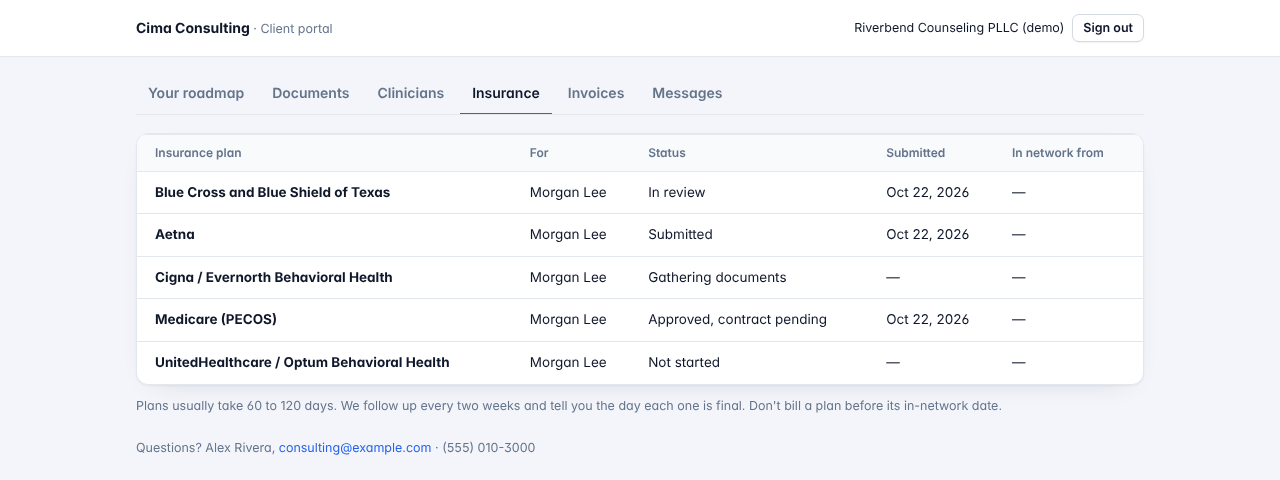
You see every application in your portal as it moves: gathering documents, submitted, in review, payer asked for more, approved, contract to sign, contract signed, and in network. If a plan says no or its panel is closed, we tell you plainly and what we can try next.
How long it takes
From a complete application to in-network, by kind of plan. These are typical ranges; plans set their own pace, and some take longer.
| Plans | Typical time | Reads CAQH |
|---|---|---|
| Commercial plans Aetna, Cigna / Evernorth Behavioral Health, UnitedHealthcare / Optum Behavioral Health, Blue Cross and Blue Shield of Texas | 45–120 days | Yes |
| Medicare (PECOS) | 30–90 days | No |
| Medicare Advantage plans Humana (Medicare Advantage), Medicare Advantage plans | 60–120 days | Yes |
| Texas Medicaid (TMHP) | 30–60 days | No |
| Texas Medicaid and CHIP managed care plans Superior HealthPlan, Wellpoint Texas (formerly Amerigroup), Molina Healthcare of Texas, Community Health Choice and 9 more | 60–120 days | Yes |
| Marketplace plans Ambetter (marketplace), Oscar Health (marketplace) | 60–120 days | Yes |
| Behavioral health managers Magellan Healthcare, Carelon Behavioral Health (formerly Beacon Health Options) | 60–120 days | Yes |
| Employee assistance and benefit networks ComPsych (EAP), Lyra Health, Spring Health | 30–90 days | No |
| TRICARE and VA Community Care TRICARE, VA Community Care Network | 60–120 days | No |
Because of these timelines, many clinicians open with self-pay clients and add each plan as it becomes effective. Programs can ask a plan for a single case agreement for one client while a contract is pending.
What we need from you
- Your professional licenses, and your NPI numbers (individual and, for a practice, organization). If you don't have NPIs yet, they're free from NPPES, and every launch package gets them for you.
- A signed W-9 and the IRS letter with your EIN, with the legal name exactly as filed.
- Your malpractice declarations page. Many plans ask for $1 million per claim and $3 million a year.
- A CV with month and year for every job, your diplomas and any board certificates.
- DEA and CLIA certificates, if you have them; a voided check or bank letter for direct deposit.
- For programs: the facility license and the organization's liability certificate.
- Your Social Security number, date of birth and home address. In your portal they're encrypted the moment they're saved and shown masked.
Texas Medicaid and managed care
- Enroll with TMHP first. Texas Medicaid enrollment goes through TMHP's Provider Enrollment and Management System (PEMS). Enrollment alone doesn't put you in network: most Texas Medicaid clients are in managed care.
- Then each managed care plan. STAR, STAR+PLUS, STAR Kids and CHIP clients get care through managed care plans that differ by service area (for example Superior HealthPlan, Wellpoint, Molina and the local plans). Each has its own application and contract. Check HHSC's current list of plans for your area.
- One verification for all of them. Texas Medicaid plans use a single credentialing verification organization run through the Texas Association of Health Plans, so the primary-source checks of your documents run through one place for every Medicaid plan (TAHP).
- LPCs and LMFTs: since March 2024, Texas Medicaid has required Medicare enrollment before Medicaid enrollment, unless you qualify for the pediatric exemption (BCBSTX Medicaid notice).
- SUD programs enroll as a licensed chemical dependency treatment facility. Check which services Texas Medicaid pays your license or program type for before planning on it.
- Revalidate on time. Medicaid enrollment must be revalidated at least every five years, online in PEMS; HHSC suggests filing at least 120 days before your due date. A missed revalidation ends your enrollment (HHSC).
Medicare
- We enroll each clinician and the practice in PECOS and reassign each clinician's billing to the practice. There's no Medicare application fee for individual clinicians or clinician groups.
- Since January 1, 2024, Medicare pays marriage and family therapists and mental health counselors (in Texas, LMFTs and LPCs), alongside LCSWs, psychologists, nurse practitioners and physicians (CMS). Addiction counselors such as LCDCs generally can't bill Medicare on their own.
- Freestanding IOP and PHP programs generally can't bill Medicare for those levels of care; hospitals and community mental health centers can.
- Many older clients have a Medicare Advantage plan instead, and each one credentials you separately, usually after you're enrolled in Medicare.
Keeping it current
Credentials lapse quietly. CAQH needs re-attesting every 120 days or plans can't use it; plans recredential about every three years; Medicare revalidates about every five. Credentialing upkeep is $49 per clinician a month:
- CAQH re-attestation every 120 days
- License, malpractice and DEA expirations tracked and renewed on time
- Recredentialing and Medicare / Medicaid revalidation
- Address, phone and roster changes sent to every plan
Credentialing guides
Doing it yourself, or want to know exactly what we'll do? These guides walk through each piece, and the credentialing cost calculator totals your plans, CAQH, Medicare and Medicaid in a minute.
| Topic | Guides |
|---|---|
| Getting started | How to get credentialed with insurance · The CAQH ProView guide · NPI Type 1 vs Type 2 · How long credentialing takes |
| By plan | Blue Cross and Blue Shield of Texas · Aetna · Cigna / Evernorth · UnitedHealthcare / Optum · Medicare for LPCs and LMFTs · Texas Medicaid and the MCOs · TRICARE |
| By license | LPC · LCSW · LMFT · Psychologist (LP, PLP, LPA) · LCDC · Psychiatric nurse practitioner |
| Texas Medicaid | Texas Medicaid health plans by service area · Superior HealthPlan · Wellpoint Texas · Texas Medicaid for IOP and PHP programs |
| Programs and groups | Insurance contracts for an IOP or PHP · When the network is closed · Single case agreements · Negotiating rates |
Questions
Can you guarantee I'll get into a network?
No one honestly can. Each plan decides, and some close their panels in some areas. We make sure every application is complete and right the first time, follow up every two weeks, and tell you plainly when a plan says no and what we can try next.
How long does credentialing take?
Usually 60 to 120 days per plan once the application is complete; Medicare and TMHP enrollment are often quicker, and some Medicaid managed care plans take longer. We give you each plan's status and next follow-up date in your portal.
Can I see a plan's members while my application is pending?
Not as in-network. Claims before the effective date usually deny. See them as self-pay with a good faith estimate, or, for a program, ask the plan for a single case agreement in writing before admission.
Do you sign applications for me?
No. You sign every application and contract. We prepare them, file them and follow them up.
Do you work outside Texas?
Yes. Texas is home, and we credential with national plans and other states' Medicaid programs too. Steps that differ by state are checked against that state's current rules.
Is this cheaper inside a launch package?
Launch packages include CAQH and a set number of plans (three to eight for practices, eight or more facility contracts for programs), along with everything else you need to open. If you're already open, buy just the items above.
Opening a practice or program?
Every launch package includes credentialing, on one dated roadmap.
Solo Practice Launch: Essentials
$1,950 · The must-haves to open a solo therapy practice and take insurance.
See what's included →Solo Practice Launch: Complete
$3,450 · Everything in Essentials, more payers, billing set up and your practice findable online.
See what's included →Prescriber Practice Launch
$4,950 · For psychiatric and family nurse practitioners and physicians opening their own practice.
See what's included →Group Practice Launch
$7,500 · Open or grow a group: group contracts, every clinician credentialed, hiring and supervision set up.
See what's included →IOP / PHP Program Launch
$24,500 · A licensed outpatient program from plan to first admission: state license, policies, clinical program, credentialing and billing.
See what's included →Program Launch + Accreditation
$32,500 · The full program launch, carried through Joint Commission or CARF accreditation.
See what's included →Recovery Residence Launch
$3,500 · Open a sober living home that is safe, certified and run like a business.
See what's included →