Service · Credentialing for groups and programs
Credentialing services for group practices and treatment programs.
For a group or a program, credentialing isn't one application. It's a group or facility contract with each plan, every clinician linked to it, each new hire added before their first in-network session, and a roster that stays current for years. We do all of it at flat prices per item, follow up every two weeks until each plan decides, and confirm every effective date in writing.
You sign every application and contract. Plans decide who joins their networks and when; we never promise approval or a date.
- $3,800 Group contract with 4 plans
- $1,050 3 CAQH profiles built and attested
- $3,300 Each clinician with each plan (12)
- $8,150 In all, then $297 a month to keep it current
Solo clinician? The credentialing page prices one clinician's plans.
The short answer: a credentialing service for a group or program files the organization's contract with each insurance plan, credentials each clinician and links them to the group's tax ID and NPI, enrolls Medicare and Texas Medicaid where they apply, and keeps everyone current afterward. Ours is $950 per plan for each group or facility contract, $275 per plan for each clinician with each plan, $350 per clinician for a CAQH profile and $99 per clinician a month for upkeep. Most plans take 60 to 120 days from a complete application.
What you end up with
- A contract with each plan you chose, in the group's or the program's own name, with the rates, timely filing limit and termination terms reviewed before you sign.
- Every clinician linked. Each one credentialed and attached to the group's tax ID and Type 2 NPI with each plan. A missing link is one of the most common reasons a new clinician's claims deny.
- Effective dates and provider IDs in writing, loaded into your EHR, so the front desk knows exactly when each clinician can see each plan's members in network.
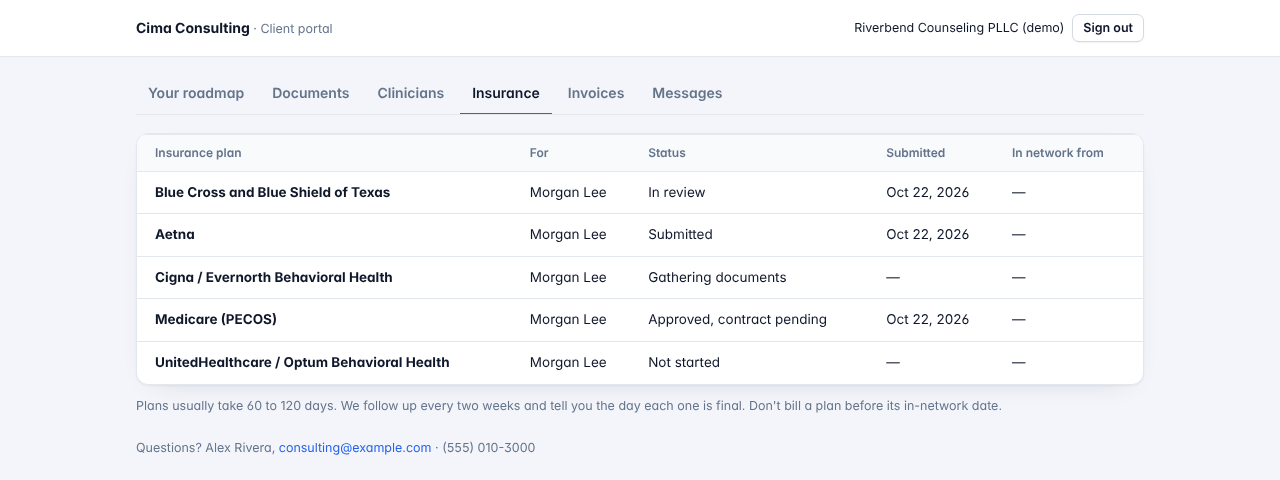
- One place to see every application. In your client portal each one moves through gathering documents, submitted, in review, payer asked for more, approved, contract to sign, signed and in network, with the next follow-up date.
- Nothing lapses afterward. CAQH re-attested every 120 days, licenses and malpractice renewed before they expire, recredentialing and revalidation filed on time, and every address or roster change sent to every plan.
Who it's for
| You are | What we usually do |
|---|---|
| A group opening with two or more clinicians | Group contracts, every clinician credentialed and linked, Medicare and Medicaid where they fit. Opening from scratch? The Group Practice Launch includes this with everything else. |
| A group that's growing | Each new hire's CAQH profile and plans filed the week they sign, so they can see in-network clients as soon as possible |
| A newly licensed IOP or PHP | Facility contracts with your target plans, filed the day the license arrives, and single case agreements in the meantime |
| A program that just got accredited | Applications to the plans that require accreditation, and TRICARE |
| An open practice or program with a mess | A clean-up: which clinicians are linked to which plans, what's expired, what's missing, then upkeep so it doesn't happen again |
Prices
Flat, per item, and never a share of what you bill:
| Service | Price |
|---|---|
| Facility or group contract: one plan A program or group contract with one insurance plan: the organization application, site visit and contract. Includes: Organization application; Site visit preparation if the plan does one; Contract and rate review checklist; Effective date and billing set-up confirmed. | $950 per plan |
| Credentialing: one insurance plan One clinician with one insurance plan, from application to effective date. Includes: Application filed; Follow-up every 2 weeks until decided; Contract review checklist (rates, timely filing, termination); Effective date confirmed and loaded in your EHR. | $275 per plan |
| CAQH ProView profile Your CAQH profile built from your documents, uploaded, authorized for your payers and attested. Includes: Profile built and documents uploaded; Payers authorized to view it; First attestation. | $350 per clinician |
| Medicare enrollment (PECOS) Medicare enrollment for an individual clinician, with reassignment to your group. Includes: PECOS application; Reassignment to the group; Revalidation date tracked. | $500 per clinician |
| Medicaid enrollment State Medicaid enrollment and the first managed care plan. Includes: State enrollment (Texas: TMHP); One Medicaid managed care plan; Revalidation date tracked. | $500 per clinician |
| Credentialing upkeep We keep every clinician's credentials current, every month. Includes: CAQH re-attestation every 120 days; License, malpractice and DEA expirations tracked and renewed on time; Recredentialing and Medicare / Medicaid revalidation; Address, phone and roster changes sent to every plan. | $99 per clinician a month |
Totals for your own numbers take a minute in the credentialing cost calculator.
Four worked examples
| Situation | What's filed | One-time | Then monthly |
|---|---|---|---|
| New group: 3 clinicians, 4 commercial plans | 4 group contracts, 3 CAQH profiles, 12 clinician applications | $8,150 | $297 |
| New hire joining a group already in 5 plans and Medicare | CAQH profile, 5 plan applications linked to the group, Medicare enrollment with reassignment | $2,225 | $99 |
| New IOP: licensed, 6 target plans, 8 clinical staff | 6 facility contracts (each with site-visit preparation if the plan does one) | $5,700 | $792 |
| Just accredited: 3 plans that required it | 3 facility contracts, the accreditation letter attached | $2,850 | — |
Two comparisons worth making. The Group Practice Launch ($11,500) includes 2 clinicians with 5 plans each and the group contracts, plus the handbook, supervision plan, billing set-up and EHR; each extra clinician is $1,250. And for an open program, the program compliance partner ($5,500 per month) includes upkeep for up to 8 clinicians along with monthly chart audits.
Government enrollments carry their own rules on fees: Medicare charges no application fee to individual clinicians or clinician groups, while institutional providers may owe one; we tell you before anything is due.
What's different for groups
- Two NPIs, two layers. The group has a Type 2 NPI and its own contract; each clinician has a Type 1 NPI and is credentialed individually, then linked (NPI Type 1 vs Type 2).
- Medicare reassignment. The group enrolls, and each clinician reassigns payment to it; a reassignment is effective 30 days before the Medicare contractor receives it (42 CFR 424.522). For clinicians, retroactive billing is limited to 30 days before the effective date, and only in narrow circumstances (42 CFR 424.521), so a new hire's Medicare application goes in before their first Medicare client. Since 2024, LPCs and LMFTs can enroll too (CMS).
- Texas Medicaid's faster lane for joiners. Medicaid managed care plans must run an expedited process for LCSWs, LPCs, LMFTs and psychologists who join an established group that already holds the plan's contract, if the clinician is Medicaid-enrolled (1 TAC §353.423). The plans share one credentialing verification organization through the Texas Association of Health Plans, and the managed care contract sets a 90-day target from a complete application (TAHP). LPCs and LMFTs must enroll in Medicare before Texas Medicaid unless they qualify for the pediatric exemption (Texas Medicaid credentialing).
- Associates and interns. Plans differ on whether they'll credential pre-licensed clinicians at all. We check each of yours before you build a schedule around it (hiring and supervising associates).
- Closed panels. A plan closed to new practices may still add a clinician to an existing contracted group, or take an exception request for a language, specialty or underserved area (when the network is closed).
What's different for programs
- The license comes first. Plans contract with an IOP or PHP as a facility, and the application asks for the state license, liability certificates, policies and often a site visit. In Texas that means the HHSC chemical dependency treatment facility license for SUD programs.
- Ask two questions of every plan. Does it also credential your clinicians individually, and does it require accreditation first? Many commercial plans contract with IOPs and PHPs only once they're accredited, and TRICARE requires Joint Commission, CARF or COA accreditation (accreditation consulting).
- The codes go in the contract. Facility contracts should name the revenue codes and HCPCS codes you'll bill for each level of care and the rate for each; see insurance contracts for an IOP or PHP and negotiating rates.
- Bridge the gap with single case agreements. While a contract is pending, a plan may agree to pay for one client at a rate agreed in writing before admission (single case agreements).
- Texas Medicaid for programs has its own enrollment path and benefit limits; read Texas Medicaid for IOP and PHP before you count on it.
Upkeep: the part that saves the most money
Groups rarely lose money on the first round of credentialing. They lose it later: a CAQH profile that went unattested, so the plan's recredentialing stalled; a malpractice certificate that expired; a clinician who moved suites and was never updated; a Medicare revalidation letter nobody opened. Each one shows up as denied claims weeks after the fact. Credentialing upkeep is $99 per clinician a month:
- CAQH re-attestation every 120 days
- License, malpractice and DEA expirations tracked and renewed on time
- Recredentialing and Medicare / Medicaid revalidation
- Address, phone and roster changes sent to every plan
For context: CAQH (now DataSpring) asks for re-attestation at least every 120 days (CAQH ProView guide), plans recredential about every three years, and Texas Medicaid enrollment must be revalidated at least every five years, with HHSC suggesting you file at least 120 days ahead (HHSC).
How we work with your team
- Documents once. Each clinician uploads their packet to the client portal once (the credentialing documents checklist lists it). SSNs, dates of birth and home addresses are encrypted the moment they're saved, and never sent by email.
- An authorization, not your passwords. You sign a credentialing authorization naming the plans we act on; where a plan allows a delegated or surrogate user, we're added, and removed when the engagement ends.
- Your biller stays. We hand them a roster with every provider ID and effective date, and ERA and EFT enrollment if you want it. If your biller already does part of the credentialing, we price the rest.
- You sign. Every application, attestation and contract. Follow-ups to plans are sent by a consultant, never automatically.
Do it yourself, hire, or outsource
| Option | Fits when | Watch out for |
|---|---|---|
| Do it yourself | A small group with an owner who has time and patience, and a few plans | Follow-up slips when the schedule fills; upkeep is the part people forget. Start with how to get credentialed with insurance. |
| An in-house coordinator | You add clinicians constantly and can keep one person busy with credentialing and enrollment | One person's knowledge walking out the door; cover for vacations and turnover |
| A credentialing service | Hiring is lumpy, a program needs facility contracts, or nobody owns it today | Per-month pricing that charges for idle months, fees tied to your collections, and anyone who promises approval |
Send us your roster and plan list.
On a free 30-minute call we'll go through who's linked to what, what's expiring and which plans are open in your area, and give you a flat quote for the rest. The full how-it-works, with every timeline, is on the credentialing page.
Questions
How much do credentialing services cost for a group practice?
With us: $950 per plan for each group contract, $275 per plan for each clinician with each plan, $350 per clinician per CAQH profile, and $99 per clinician a month for upkeep. A new 3-clinician group with 4 plans comes to $8,150 one time. Compare quotes item by item; what consultants charge shows how.
What's the difference between facility credentialing and provider credentialing?
Facility (or group) credentialing contracts the organization with the plan under its own tax ID and Type 2 NPI. Provider credentialing approves each clinician individually and links them to that contract. Programs usually need the facility contract; some plans also credential the program's clinicians.
How long does group credentialing take?
Usually 60 to 120 days per plan once the application is complete, sometimes longer, and Texas Medicaid managed care has a 90-day target. A new clinician joining an existing group contract is often quicker than a brand-new group contract. See how long credentialing takes.
Can a new hire see a plan's members before their effective date?
Not as in network; those claims usually deny. Schedule them with self-pay clients or plans where they're already effective, and, for Medicare, file before their first Medicare visit.
Do you handle recredentialing and revalidation?
Yes, under upkeep: CAQH re-attestation, recredentialing, Medicare and Texas Medicaid revalidation, expirations and roster changes, for $99 per clinician a month.
Can you guarantee we'll get into a network?
No. Each plan decides, and some panels are closed in some areas. We file complete applications, follow up every two weeks, and tell you plainly when a plan says no and what to try next.
Do you work outside Texas?
Yes, with national plans and other states' Medicaid programs. State-specific steps are checked against that state's current rules.
Sources
- 42 CFR 424.522, reassignment and 42 CFR 424.521, retrospective billing (Cornell LII)
- CMS, Marriage and family therapists and mental health counselors
- Texas Administrative Code, 1 TAC §353.423, expedited credentialing
- Texas Association of Health Plans, Medicaid credentialing (90 days from a complete application)
- HHSC, Texas Medicaid provider revalidation
- Defense Health Agency, TRICARE Policy Manual, chapter 11, intensive outpatient programs
Updated October 24, 2026. Plan rules and timelines change; we check each plan's current requirements before filing.
Get every clinician in network, and keep them there.
Start with a free 30-minute call.
Book a free call