Service · IOP, PHP and treatment center consulting
An IOP consultant who runs a licensed program, at a published flat fee.
We run a licensed Texas outpatient program, PHP through outpatient, and built the EHR it runs on. We take an IOP or PHP from the first feasibility check to the state license, the policy manual, the clinical program, the staff files, the insurance contracts and the first admission, on a dated roadmap you can see every day. Prices are on this page, paid by milestone, and never tied to your census or revenue.
Not a law or accounting firm. Agencies, accreditors and insurance plans make their own decisions; we never promise a license, contract or date.
- Free 30-minute call: what it would take, and whether you need us
- $495 Roadmap session, credited toward a package within 30 days
- $39,500 IOP / PHP Program Launch, plan to first admission
- $54,500 The same, carried through Joint Commission or CARF
- $275 an hour for anything else
Already open? See accreditation, credentialing and policy manuals on their own.
The short answer: an IOP or treatment center consultant does the operational work of opening a program: the feasibility numbers, the site checklist, the state license application (in Texas, the HHSC chemical dependency treatment facility license under 26 TAC chapter 564), the policy manual, the clinical program, staffing, insurance contracts and, if you need it, accreditation. Ours is $39,500 flat for the full launch, paid in four parts tied to the license and your first admission. You still need a health-care attorney and a CPA, and you sign everything yourself.
Who we are
Cima Consulting is the services side of Cima. The people doing the work run a licensed Texas outpatient substance use program (PHP, IOP and outpatient) and built Cima EHR to run it. Every template, checklist and roadmap step we hand you is one we use, or wrote after doing that step ourselves: the HHSC application, the policy manual, the group curriculum, the credential files, the authorization and continued-stay workflow.
That's the whole pitch, and it cuts both ways. We're operators, not lawyers or accountants: your attorney reviews the legal documents and settles ownership and medical director arrangements (Texas has a strong corporate practice of medicine doctrine), and your CPA handles the entity and taxes. We'll tell you when a question needs one of them.
What we do for a program
The IOP / PHP Program Launch covers the whole path to first admission. Everything included:
- Feasibility review and 3-year financial projection
- Site requirements checklist: zoning, certificate of occupancy, fire inspection
- State facility license application prepared (Texas: HHSC chemical dependency treatment facility license)
- Full policy and procedure manual, written for your program, organized by accreditation chapter
- Intake packet, consents and 42 CFR Part 2 releases
- Clinical program design: levels of care, schedule, curriculum, ASAM-based admission and continued-stay criteria
- Staffing plan, job descriptions and credential files
- Facility credentialing with 8 insurance plans
- Utilization review and authorization workflow
- Cima EHR Program plan set up
- 6 months of support after opening
A few of those deserve a sentence each:
- The license comes first, and its clock is unforgiving. In Texas, an SUD program must hold an HHSC chemical dependency treatment facility license before it treats anyone (Health and Safety Code chapter 464). Once you file, you have 6 months to show HHSC you meet 26 TAC chapter 564, or the application is denied. We file when the site, policies and staff files are close to ready, not before. Our CDTF license guide walks through the forms.
- The manual is written for your program. Organized by accreditation chapter, with every 26 TAC 564 rule matched to the policy, form or record that meets it. See the policy and procedure manual for what's in it.
- Contracts follow the license. Most plans contract with a program only after the license is issued, and many IOP and PHP contracts require accreditation. TRICARE requires IOPs and PHPs to be accredited by the Joint Commission, CARF or COA (TRICARE Policy Manual, chapter 11). We tell you which of your target plans require it before you spend money on it.
- Mental-health-only programs fall under different rules; a freestanding mental health IOP may not need a facility license at all. We confirm the path with HHSC and your attorney first (mental health IOP licensing in Texas).
What an engagement looks like, week by week
Days 1 to 3
- You get an invitation to your client portal: your roadmap, your to-dos with dates, documents both ways, insurance applications, invoices and messages. You turn on two-step sign-in.
- We send the document checklist for a program and schedule the kickoff.
Week 1: the kickoff call (60 to 90 minutes)
- Your goals, levels of care, location, timeline and budget.
- The roadmap, step by step: what we do, what you do, and in what order.
- The decisions we need early: the entity (filed by you or your attorney), the program name, the site, and which insurance plans to target.
- Who to contact for what, and next steps for each of us, with dates.
Week 2
- We review what you've uploaded and tell you exactly what's still missing.
- The first steps on your roadmap start: usually the business formation (filed by you or your attorney), then the organization's NPI.
- You get a short questionnaire about your program so the manual and forms fit it, and your first weekly status update. Updates come every week until you open; we answer messages within one business day.
After that, milestone by milestone
Our Texas SUD program roadmap has 118 steps, with an owner and a due date for each, and the fee and official link where one applies. On the earliest path, the first admission comes in about 6 months. The site, the license inspection and the insurance plans set the real pace, so treat these as typical, never promised:
| Step | Typical timing |
|---|---|
| Kickoff and your dated roadmap | Week 1 |
| Business formed with the Texas Secretary of State (you or your attorney file) | Week 4 |
| Policy and procedure manual written | Weeks 5–10 |
| Cima EHR Program plan set up | Weeks 13–15 |
| Site leased, after the city confirms zoning | Weeks 13–16 |
| Individual NPI for each clinician | Weeks 15–16 |
| Team hired and verified | Months 4–5 |
| HHSC facility license application filed | Months 4–6 |
| Soft opening, mock admission and fire drill | Months 6–7 |
| HHSC compliance inspection | Months 6–7 |
| Facility contracts with the insurance plans | Months 6–9 |
| First admission | Month 7 |
| Mock accreditation survey | Month 7 |
| Accreditation survey | Months 7–8 |
| Accreditation decision | Months 8–10 |
| Each plan's effective date confirmed | Month 10 |
| Billing each plan from its effective date | Month 10 |
From the kickoff, on the earliest path through our 118-step Texas roadmap. Agencies and insurance plans set their own pace, so treat these as typical, not promised.
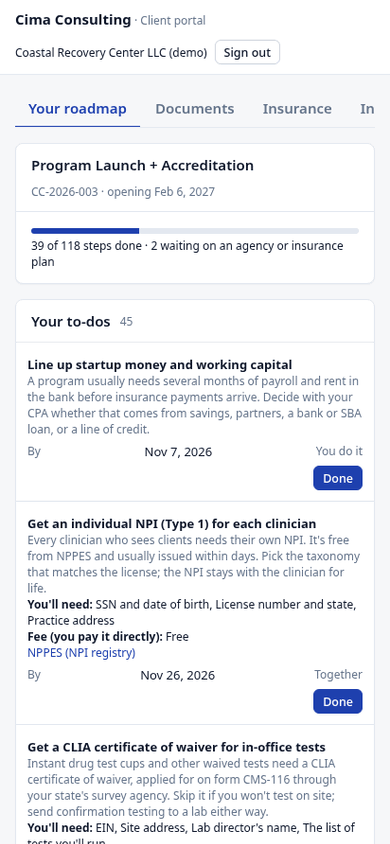
You can tour the client portal with a made-up program to see the roadmap, documents and insurance tabs before you call.
Who does what
| Step | We do | You do |
|---|---|---|
| Roadmap and schedule | Build it and keep it current | Review it and make the decisions |
| Business set-up | The checklist and your choices explained | File with the state and IRS, yourself or through your attorney or CPA |
| License and insurance applications | Prepare, submit and follow up (every 2 weeks with each plan) | Give accurate information, then review and sign |
| Government and accreditation fees | Tell you what's due and when | Pay the agency directly |
| Policies and forms | Draft them under your program's name | Review with your attorney; your governing body adopts them |
| Site and people | The site checklist, staffing plan, job descriptions and credential files | Lease the building and hire the team |
| Clinical care and billing | Set up the EHR, the UR and authorization workflow, and the billing set-up | Provide care and bill under your own license, NPI and tax ID |
What we don't do
- Promise outcomes. HHSC, the accreditors and the plans decide licenses, accreditation, network participation, rates and effective dates. Anyone who guarantees them is guessing or worse.
- Send you patients, or introduce you to people who sell them. We never refer patients or take anything of value for referrals. See patient brokering laws for why that line is bright in addiction treatment.
- Take a share of anything. No fee tied to admissions, census, claims, collections or revenue (more on why below).
- Make clinical decisions. Admissions, discharges, level of care, clinical staffing and supervision stay with your clinical director. We design the program and the criteria; your licensed staff run it.
- Sign for you, or bill under our numbers. You sign every application, attestation and contract. A license, NPI and contract belong to one organization; billing under someone else's misrepresents who gave the care.
- Give legal, tax or accounting advice, find the building or recruit the staff. We give you the checklists and the plan; you lease and hire.
Packages and prices
Two launch packages for programs, and the pieces on their own for programs that are already partway there or already open:
IOP / PHP Program Launch
$39,500 · A licensed outpatient program from plan to first admission: state license, policies, clinical program, credentialing and billing.
See what's included →Program Launch + Accreditation
$54,500 · The full program launch, carried through Joint Commission or CARF accreditation.
See what's included →| Service | Price |
|---|---|
| Launch roadmap session 90 minutes with a consultant and your own written, dated roadmap from today to opening day. Includes: Readiness review of your license, entity and location; Your step-by-step roadmap with dates and fees; Startup budget worksheet; Credited in full toward any launch package within 30 days. | $495 |
| State facility license application Your program's state license application prepared and filed, and the inspection prepared for. Includes: Application and operational plan (Texas: HHSC forms and 26 TAC 564); Required policies checked against the rules; Inspection-readiness walkthrough. | $7,500 |
| Program policy and procedure manual A full policy manual written for your program, organized by accreditation chapter, in Word. Includes: Every chapter: rights, care, records, medications, infection control, safety, emergency management, HR, leadership, performance improvement; Environment-of-care and emergency plans; State-rule crosswalk; Editable Word files. | $7,500 |
| Mock survey A one-day survey the way an accreditor or state surveyor would do it, with a written report and fix list. Includes: Leadership, environment and record tracers; Chart audit sample; Written findings and corrective-action plan. | $6,500 |
| Program compliance partner Monthly compliance for an open program: chart audits, policy updates, survey readiness. Includes: 10 charts audited every month; Policy updates when the rules change; Quarterly mock tracer; Credentialing upkeep for up to 8 clinicians; Survey and inspection support. | $5,500 per month |
| Operator advisory A standing line to an operator who runs a program: 6 hours a month, priority answers. Includes: 6 consulting hours a month; Priority email and text; Monthly check-in on numbers and compliance; Credentialing upkeep for 2 clinicians. | $2,500 per month |
| Consulting by the hour A consultant's time for anything not in a package. Includes: Billed in 15-minute steps; Notes after every call. | $275 per hour |
Already licensed and need accreditation? Accreditation readiness is $16,500, mock survey included.
Government, licensing and accreditation fees are paid by you, directly to the agency. In Texas the CDTF license is $1,200 for a two-year license plus $125 for each additional site (26 TAC 564), and the Joint Commission takes a $1,700 deposit with the application; the full startup budget covers the rest, and what consultants charge explains how to compare our prices with anyone else's.
How we're paid, and why it's never a percentage
Launch packages are flat, paid in parts as the work lands. For the program launch:
| When | Share | Amount |
|---|---|---|
| At signing | 30% | $11,850 |
| When the license application is filed | 30% | $11,850 |
| When the license is issued | 30% | $11,850 |
| At first admission | 10% | $3,950 |
| Total | 100% | $39,500 |
The last payment comes at first admission because that's the point of the work. If either side ends the engagement early, the milestones already reached stay due, work toward the next one is billed by the hour up to that milestone's payment, and nothing after it is owed.
We don't take a percentage of revenue, a fee per admission or a bonus tied to census, even when a client asks for one to lower the up-front cost. Three laws are the reason:
- EKRA (18 U.S.C. 220) makes it a federal crime to pay or receive anything of value for referrals to a clinical treatment facility, recovery home or lab, under any payer, including commercial insurance. Its exception for employees and contractors covers pay only when it isn't determined by, and doesn't vary with, the number of people referred, the tests or procedures performed, or the amount billed or received.
- The federal Anti-Kickback Statute (42 U.S.C. 1320a-7b(b)) reaches Medicare, Medicaid and other federal programs. Its safe harbor for personal services contracts asks for compensation set by a method fixed in advance, at fair market value, that doesn't take into account the volume or value of referrals (42 CFR 1001.952(d)).
- The Texas Patient Solicitation Act (Occupations Code chapter 102) bans paying or accepting anything for securing or soliciting patients, whatever the payer, self-pay included.
A consultant whose fee rises with your admissions is a consultant with a financial reason to care about volume. In addiction treatment that can look like payment for patients, and it puts the risk on your license, not theirs. Flat fees for defined work keep it clean. Ask your own attorney about any contract that ties a vendor's pay to your census or collections.
Ten questions to ask any IOP consultant
Use these on every call, ours included. The answers sort the operators from the template sellers fast.
| Ask | A good answer | A red flag |
|---|---|---|
| 1. Do you run a licensed program yourselves? | Yes: which state, which levels of care, and for how long | "We've worked with hundreds of programs," with no names, license or proof |
| 2. Is the price fixed, and what triggers each payment? | A written price with milestones you can verify (filed, issued, admitted) | A monthly retainer with no end date for a launch |
| 3. Is any fee tied to admissions, census or revenue? | No | A percentage, a per-admission fee or a "success bonus" |
| 4. Do you guarantee the license, accreditation or contracts? | No, with an honest range for each | A guaranteed date or a "guaranteed in-network" |
| 5. Is the manual written for my program? | Yes, from your program description, with a crosswalk to your state's rule | A purchased template with your name typed in |
| 6. Who signs and who files? | They prepare and file; you sign | They'll sign for you or bill under their own numbers until yours come through |
| 7. Which fees are separate? | A list: license, accreditation, filings, insurance, attorney, CPA | "Everything's included" with no list |
| 8. Can you help us get referrals? | Yes, the legal way: outreach, fast intake, updates to referrers | An offer to connect you with marketers, call centers or sober homes that "send patients" |
| 9. What happens if I stop halfway? | Pay for milestones reached; the work done so far is yours | The full fee is due no matter what |
| 10. Who do I talk to every week? | A named consultant, a weekly status update and one place to see everything | A sales rep, then a ticket queue |
Want the roadmap before you decide?
The launch roadmap session ($495) is 90 minutes with a consultant and your own written, dated roadmap and startup budget, credited in full toward the IOP / PHP Program Launch if you sign within 30 days. Or start with the free call.
Questions
What does an IOP consultant do?
The operational work of opening and running an intensive outpatient program: feasibility and budget, the site requirements, the state license application, the policy and procedure manual, the clinical program and schedule, staffing and credential files, insurance contracts, utilization review and, often, accreditation. A good one also tells you what stays with your attorney, CPA and clinical director.
How much does a treatment center consultant cost?
Ours is $39,500 for a full IOP or PHP launch, or $54,500 carried through accreditation, plus government and accreditation fees you pay directly. Pieces are priced on their own, from $275 per hour for advice to $7,500 for a program policy manual. Many firms quote only after a call; our guide to what behavioral health consultants charge shows how to compare quotes line by line.
How long does it take to open an IOP with a consultant?
On our Texas SUD roadmap the first admission comes in about 6 months on the earliest path, and a full caseload of insured clients usually takes nine to twelve months, because most plans contract only after the license is issued. A consultant removes delays on your side; nobody controls HHSC's or a plan's pace.
Do you work outside Texas?
Texas is home, and our roadmaps cover other states with every state-specific step flagged to check against that state's current rules and confirmed with its agency. Start with how to start an IOP in any state and book a call.
We already have a license. Can you help with just part of it?
Yes. Accreditation, credentialing, the policy manual, a mock survey, chart audits and training are each priced on their own, and the program compliance partner ($5,500 per month) covers monthly audits, policy updates and survey readiness for an open program.
You run a program. Aren't you my competition?
Maybe, if you open near us. What we share is how to run a program: the steps, the policies and the systems. Not our patients, referral sources, staff or payer rates, and we don't ask for yours. Your plans stay confidential under our agreement.
Will you send us patients once we open?
No, never. We don't refer patients to consulting clients or take anything of value for referrals, and no consulting deal touches patient referrals. We'll help you build referrals the legal way; see marketing a treatment center.
Does the package include the EHR?
Yes, six months of the Cima EHR Program plan, set up with your levels of care, groups, forms and authorization tracking. After that it's the plan's published monthly price on Cima EHR pricing, and you can cancel.
Sources
- Texas Legislature, Health and Safety Code chapter 464, facilities treating persons with a chemical dependency
- Texas Administrative Code, 26 TAC chapter 564, chemical dependency treatment facilities (Cornell LII), including the license fee in subchapter D
- HHSC, Chemical dependency treatment facilities
- Defense Health Agency, TRICARE Policy Manual, chapter 11, intensive outpatient programs
- 18 U.S.C. 220, the Eliminating Kickbacks in Recovery Act (Cornell LII)
- 42 U.S.C. 1320a-7b(b), the federal Anti-Kickback Statute (Cornell LII), and 42 CFR 1001.952(d), personal services and management contracts (eCFR; the methodology-set-in-advance wording took effect January 19, 2021)
- Texas Legislature, Occupations Code chapter 102, solicitation of patients
- Joint Commission, Facts about behavioral health care accreditation (the $1,700 application deposit)
Updated October 24, 2026. Cima Consulting is not a law firm or an accounting firm and doesn't give legal or tax advice.
Open a program you'd trust with your own family.
A free 30-minute call with an operator: your program, your timeline, and what it would really take.
Book a free call