Service · Mental health IOP and PHP
Mental health IOP consulting in Texas, from the licensing question to the first admission.
We open mental health intensive outpatient and partial hospitalization programs on the same flat-fee launch we use for substance use programs, with the one step that's different done first: getting HHSC's answer in writing on whether your model needs a facility license. Then the policy manual, the clinical program, the staff files, the payer contracts and the first admission, on a dated roadmap you can see every day. We run a licensed Texas PHP, IOP and outpatient program ourselves, and built the EHR it runs on.
Not a law firm. HHSC, accreditors and insurance plans make their own decisions; we never promise a license, contract or date.
- Free 30-minute call: your model, and whether you need us
- $495 Roadmap session, credited toward a package within 30 days
- $39,500 IOP / PHP Program Launch, plan to first admission
- $54,500 The same, carried through Joint Commission or CARF
- $7,500 the policy manual on its own
Opening a substance use program instead? See IOP consulting.
The short answer: a mental health IOP consultant does the operational work of opening a program for depression, anxiety, trauma and other mental health conditions: the licensing question, the policy manual, the clinical program and schedule, staff credential files, payer contracts, billing and, usually, accreditation. In Texas the licensing step is different from a substance use program, because the state's outpatient facility license is written for substance use and, as far as we've found, there's no license written for a freestanding mental health IOP. Ours is $39,500 flat for the full launch, or $54,500 carried through accreditation.
What's different about a mental health IOP
| Topic | Substance use IOP | Mental health IOP |
|---|---|---|
| State license | HHSC chemical dependency treatment facility license, before the first client | Doesn't fit that license: a CDTF client must meet DSM criteria for a substance use disorder (26 TAC 564.801(a)). A freestanding program run by licensed clinicians may need no facility license; get HHSC's answer in writing |
| Who provides care | Qualified credentialed counselors, such as LCDCs | Licensed clinicians (LPCs, LCSWs, LMFTs, psychologists, licensed by the Behavioral Health Executive Council) and a psychiatric prescriber; associates under their board's supervision rules |
| Common codes | H0015, or revenue code 0906 | S9480, or revenue code 0905; PHP as S0201 or H0035, or 0912 and 0913. Each plan decides, so confirm in every contract (S9480 explained) |
| Payers' proof you may operate | The state license | Often accreditation, sometimes with a letter on why no license applies. Many plans contract only with accredited IOPs and PHPs, and TRICARE requires it |
| Medicare | Pays for PHP and, since 2024, IOP only through hospitals, community mental health centers and a few other provider types (CMS, CY 2024 outpatient rule) | The same rule, so a freestanding program plans its payer mix without Medicare |
The co-occurring trap. Many mental health programs end up treating substance use, because many clients have both. Treating substance use disorders as a program points to the CDTF license and brings in 42 CFR Part 2 for those records. We help you decide which program you are, write it into the admission criteria, and plan for the license from the start if you'll treat both; see running a dual diagnosis program.
The licensing question, settled first
On our mental health roadmap, "facility license question settled with HHSC and your attorney" is its own dated step, finished before the lease is signed, because the answer can change the site, the staffing and the payer plan. We write the request with you: your program described concretely (population, diagnoses, hours a day and days a week, the clinicians and prescriber), whether co-occurring clients change the answer, whether PHP or medication on site changes it, and whether any registration or notice is required. You send it, and the reply goes in your license file, where payers will ask for it. The questions word for word are in licensing a mental health IOP or PHP in Texas. A freestanding PHP is the hardest model to answer, so we raise it with HHSC and your target plans before you design the day.
What the launch includes
The IOP / PHP Program Launch covers mental health programs and substance use programs alike. Everything included:
- Feasibility review and 3-year financial projection
- Site requirements checklist: zoning, certificate of occupancy, fire inspection
- State facility license application prepared (Texas: HHSC chemical dependency treatment facility license)
- Full policy and procedure manual, written for your program, organized by accreditation chapter
- Intake packet, consents and 42 CFR Part 2 releases
- Clinical program design: levels of care, schedule, curriculum, ASAM-based admission and continued-stay criteria
- Staffing plan, job descriptions and credential files
- Facility credentialing with 8 insurance plans
- Utilization review and authorization workflow
- Cima EHR Program plan set up
- 6 months of support after opening
For a mental health program, the state license line becomes the written licensing answer above, and the manual and clinical program are written for your population: a schedule that meets the hours payers expect (most expect at least 9 a week for adult IOP and about 20 for PHP), admission and continued-stay criteria matched to the criteria each plan uses, a group curriculum tied to treatment-plan goals, and a crisis and suicide-risk procedure. The full manual's contents are in the policy and procedure manual.
The roadmap
Our Texas roadmap for a mental health IOP or PHP has 109 steps, each with an owner, a due date, and the fee and official link where one applies. On the earliest path the first admission comes in about 6 months. HHSC, the city and the insurance plans set the real pace, so treat these as typical, never promised:
| Step | Typical timing |
|---|---|
| Kickoff and your dated roadmap | Week 1 |
| Business formed with the Texas Secretary of State (you or your attorney file) | Week 4 |
| Policy and procedure manual written | Weeks 5–10 |
| Cima EHR Program plan set up | Weeks 13–15 |
| Facility license question settled with HHSC and your attorney | Weeks 13–15 |
| Site leased, after the city confirms zoning | Weeks 13–16 |
| Individual NPI for each clinician | Weeks 15–16 |
| Team hired and verified | Months 4–5 |
| Soft opening, mock admission and fire drill | Months 6–7 |
| Facility contracts with the insurance plans | Months 6–9 |
| First admission | Month 7 |
| Mock accreditation survey | Month 7 |
| Accreditation survey | Months 7–8 |
| Accreditation decision | Months 8–10 |
| Each plan's effective date confirmed | Month 10 |
| Billing each plan from its effective date | Month 10 |
From the kickoff, on the earliest path through our 109-step Texas roadmap. Agencies and insurance plans set their own pace, so treat these as typical, not promised.
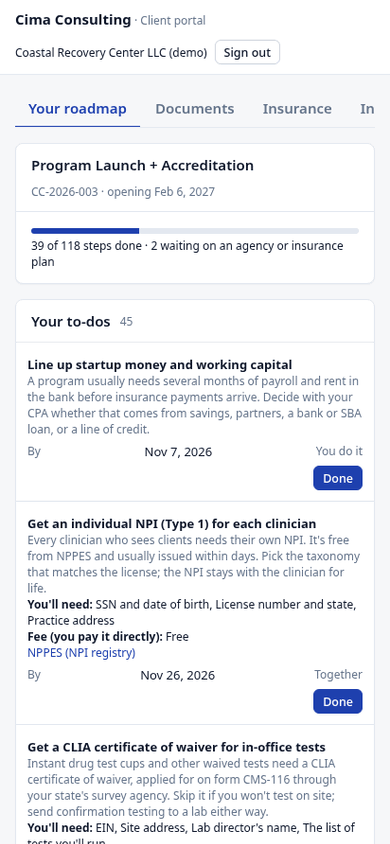
You can tour the client portal with a made-up program before you call.
Who does what
| Step | We do | You do |
|---|---|---|
| Licensing question | Draft the request to HHSC and flag what's for your attorney | Send it, and settle ownership and the prescriber's role with your attorney |
| Policies and clinical program | Write them under your program's name | Review with your clinical director; your governing body adopts them |
| Site and people | The site checklist, staffing plan, job descriptions and credential files | Lease the building and hire the team |
| Payer contracts | Prepare, submit and follow up every two weeks | Review and sign |
| Care and billing | Set up the EHR, the authorization workflow and the billing set-up | Provide care and bill under your own license, NPI and tax ID |
How we're paid
The launch is flat, paid in parts as the work lands:
| When | Share | Amount |
|---|---|---|
| At signing | 30% | $11,850 |
| When the license application is filed | 30% | $11,850 |
| When the license is issued | 30% | $11,850 |
| At first admission | 10% | $3,950 |
| Total | 100% | $39,500 |
We never take a percentage of revenue, a fee per admission or a bonus tied to census, and we never refer patients. Why fees tied to volume are a legal risk applies to mental health programs too, whatever the payer.
Prices
IOP / PHP Program Launch
$39,500 · A licensed outpatient program from plan to first admission: state license, policies, clinical program, credentialing and billing.
See what's included →Program Launch + Accreditation
$54,500 · The full program launch, carried through Joint Commission or CARF accreditation.
See what's included →| Service | Price |
|---|---|
| Launch roadmap session 90 minutes with a consultant and your own written, dated roadmap from today to opening day. Includes: Readiness review of your license, entity and location; Your step-by-step roadmap with dates and fees; Startup budget worksheet; Credited in full toward any launch package within 30 days. | $495 |
| Program policy and procedure manual A full policy manual written for your program, organized by accreditation chapter, in Word. Includes: Every chapter: rights, care, records, medications, infection control, safety, emergency management, HR, leadership, performance improvement; Environment-of-care and emergency plans; State-rule crosswalk; Editable Word files. | $7,500 |
| Facility or group contract: one plan A program or group contract with one insurance plan: the organization application, site visit and contract. Includes: Organization application; Site visit preparation if the plan does one; Contract and rate review checklist; Effective date and billing set-up confirmed. | $950 per plan |
| Accreditation readiness Get ready for a Joint Commission or CARF survey: a gap assessment, a fix plan and the evidence surveyors ask for. Includes: Gap assessment against the standards; Policy and chart fixes; Staff training and tracer practice; Application and survey scheduling; A full mock survey. | $16,500 |
| Consulting by the hour A consultant's time for anything not in a package. Includes: Billed in 15-minute steps; Notes after every call. | $275 per hour |
Government and accreditation fees are paid by you, directly. The Joint Commission takes a $1,700 deposit with the application (Joint Commission fact sheet); the rest of the budget is in what it costs to start an IOP.
Not sure your model needs a license?
Start with the free call. We'll ask what you'll treat, for whom and how many hours a day, and tell you which questions go to HHSC, which to your attorney and which to your target plans.
Questions
What does a mental health IOP consultant do?
The operational work of opening the program: the licensing question, the policy manual, the clinical program and schedule, admission and continued-stay criteria, staff files, payer contracts, the authorization workflow, billing set-up and, often, accreditation. A good one also tells you what stays with your attorney, CPA and clinical director.
Does a mental health IOP need a license in Texas?
A freestanding, mental-health-only IOP run by licensed clinicians may not need a facility license, because Texas's outpatient facility license covers substance use treatment. Each clinician needs their own license. Get HHSC's answer for your model in writing before you lease a site.
How much does a mental health IOP consultant cost?
Ours is $39,500 for the full launch, or $54,500 carried through Joint Commission or CARF, plus government and accreditation fees you pay directly. Pieces are priced on their own, from $275 per hour for advice to $7,500 for the policy manual.
How long does it take to open a mental health IOP?
On our Texas roadmap the first admission comes in about 6 months on the earliest path. Insurance contracts often wait for accreditation, which needs a program already serving clients, so plan the cash for that gap.
Will insurance pay a mental health IOP without a state license?
Often, if the program is accredited and meets the plan's criteria. Many commercial plans and TRICARE expect Joint Commission, CARF or COA accreditation for IOP and PHP. Each plan sets its own rules, so we check yours before you count on a contract.
Can you help an outpatient therapy clinic add an IOP?
Yes. The clinic's clinicians and contracts are the start; the IOP adds a program schedule, criteria, facility contracts and usually accreditation. See opening a mental health clinic in Texas and adding a level of care.
Will you send us patients?
No, never. We don't refer patients to clients or take anything of value for referrals. We'll help you build referral relationships the legal way; see marketing a treatment center.
Sources
- 26 TAC 564.801 (CDTF client eligibility); Texas Health and Safety Code chapter 464
- CMS, CY 2024 hospital outpatient final rule fact sheet
- eCFR, 42 CFR Part 2; Texas Behavioral Health Executive Council
- Joint Commission, Facts about behavioral health care accreditation
Updated October 27, 2026. Cima Consulting is not a law firm or an accounting firm and doesn't give legal or tax advice.
Settle the license question before you sign the lease.
A free 30-minute call about your program, your clients and your payers.
Book a free call